
The Trillion-Dollar Gamble: Is OpenAI a Tech Myth or Capital’s Wildest Wager?
— Countdown to Judgment Day: When a $134 Billion Claim Collides with an $830 Billion Valuation
By James Lee Strategy & Governance Expert
Executive Summary:
February 2026. The air in Silicon Valley feels solid, heavy with tension. Just last week, Judge Gonzalez Rogers of the California Federal Court issued a ruling that shattered OpenAI’s illusion of a “quick victory”—the motion for summary judgment was denied. The case will go to a jury. This means Elon Musk’s lawsuit, hundreds of pages thick and carrying a staggering price tag of $134 billion, is no longer just media fodder; it is an impending legal superstorm.
This article conducts a forensic dismantling of OpenAI’s precarious “Balance Sheet,” incorporating the latest court disclosures—including the “Brockman Diaries,” now labeled by the plaintiff as “smoking gun evidence of fraud.” Facing a lawsuit that could force Microsoft to disgorge billions in “unjust enrichment,” we ask: Is OpenAI’s trillion-dollar empire truly the ark to AGI, or is it a Titanic steaming toward an iceberg?
Prologue: Ice and Fire—Champagne in Davos vs. Subpoenas in California
In January 2026, the snows of Davos, Switzerland, remained cold and austere, yet OpenAI CFO Sarah Friar’s smile was blazing. Facing the global political and business elite, she presented a dazzling report card: annualized revenue surpassing $20 billion, a tenfold increase in two years. The OpenAI she described was a pragmatic tech titan, poised for an IPO, seemingly in total control.
However, in the same spacetime continuum, a hearing determining OpenAI’s fate was unfolding in California amidst a grim atmosphere.
If Davos showcased OpenAI’s polished “façade,” the California court revealed its bloody “underbelly.” Elon Musk, the former Chairman who wrote OpenAI’s first check for $38 million, has formally fixed his claim for damages at $134 billion.
This is not an arbitrary figure. It is calculated based on OpenAI’s current valuation of $500–$830 billion, representing the value Musk allegedly lost due to “fraudulent inducement,” alongside the disgorgement of “unjust enrichment” from Microsoft.
Most lethal was last month’s ruling: the judge determined the case involves complex “continuing breaches” and factual disputes that cannot be resolved via summary judgment. They must go to a jury. This ruling strikes like a thunderbolt. It means OpenAI’s most guarded secrets—emails and diaries from 2017 detailing plots to “get rid of Musk” and designing “capped profit” structures to circumvent non-profit obligations—will be placed under the microscope in the April trial, scrutinized word-for-word by a jury and the global media.
Here, a tension-filled paradox is born: On one side, a valuation carnival of $830 billion and the launch of the trillion-dollar “Stargate” compute project; on the other, a hundred-billion-dollar legal claim that could snap the company’s cash flow in an instant.
OpenAI now presents a severely bifurcated “Dual Narrative”:
- The Capital Market Narrative: It is the only true god of AGI, backed by Microsoft’s infinite compute, building unassailable moats through complex “circular financing.”
- The Legal Litigation Narrative: It is depicted as a “decade-long con” engineered by Greg Brockman and Sam Altman. According to evidence filed by Musk’s legal team, it is a RICO (Racketeer Influenced and Corrupt Organizations) enterprise that used a “non-profit” cloak to lure donations and talent, while secretly channeling assets into a for-profit vehicle.
Our dismantling is no longer just business analysis; it is forensic accounting. Let us open the left side of this balance sheet—the Assets—and see if what is deemed core competitiveness is, under the X-ray of the law, gold or stolen goods.
Part I: The Left Side of the Ledger—Asset Revaluation: Foundations Poisoned by the “Brockman Diaries”
Opening OpenAI’s asset list, the most prominent items are usually the ownership of GPT models, brand reputation, and the compute contract with Microsoft. However, with the disclosure of trial evidence—specifically internal communications from 2017—the legal foundation of these assets is shaking violently.
1.1 The “Original Sin” of Core Assets: From $38 Million Donation to “Fraudulent Transfer”
OpenAI’s trillion-dollar edifice is built on a seemingly humble cornerstone: the non-profit pledge made in 2015.
Back on June 24, 2015, Sam Altman wrote to Musk: “Ideally… we will comply with/aggressively support all regulation.” Musk replied: “Agreed.” Based on this “Meeting of the Minds,” Musk contributed between $38 million and $44 million starting in 2016. This money was the lifeline that bought the first GPUs and paid top scientists like Ilya Sutskever.
However, the “Magic Weapon” thrown by Musk’s lawyers—Greg Brockman’s Diaries—has shattered this foundation.
- “Transition is a Lie”: In a November 2017 note, Brockman starkly wrote: “We cannot claim we are sticking to the non-profit attribute… if we don’t do this [switch to for-profit], and three months later we switch to a B-Corp, then our previous statements become lies.”
- “Get Rid of Musk”: The notes record the team’s conspiracy: “This is our only chance to get rid of Elon,” alongside naked discussions about “What will make me a billion dollars?”
Musk’s team cites this as hard evidence of “Promissory Fraud.” This implies that OpenAI’s current core technical assets (the evolutionary path from GPT-1 to GPT-5) could legally be deemed the “Fruit of the Poisonous Tree.” If a jury finds that executives decided to abandon the non-profit mission in 2017 but continued to induce funding from Musk, OpenAI’s right to commercialize these technologies through a for-profit subsidiary comes into question.
In valuation models, this is called a “Title Defect.” The market’s $830 billion valuation assumes undisputed ownership. Now, that ownership is tagged “Pending Litigation.”
1.2 The “RICO” Shadow over Valuation: When a Business Model is Accused of Racketeering
OpenAI’s valuation multiplied 50-fold in three years based on high growth expectations from “circular financing” (buying hardware from partners who invest back in the company).
But in Musk’s amended complaint (August 2024), this model was elevated to a criminal level—citing the federal civil RICO Act. Musk alleges OpenAI and Microsoft formed an “Illegal Enterprise” engaging in wire fraud to misrepresent their humanitarian mission to the public and investors for financial gain.
This is an extremely dangerous accusation. Civil RICO claims, if proven, carry Treble Damages (triple the actual damages). This is one legal basis for the claim soaring to $134 billion.
For investors, this means the “Ecosystem Moat” on the asset side is now a potential “Crime Scene.” If Microsoft is deemed a co-conspirator, the Azure cloud contracts and billion-dollar injections could be voided or deemed unjust enrichment.
1.3 Microsoft’s “Quasi-Contract” Crisis: The Risk of Joint Liability
OpenAI’s strongest ally, Microsoft, is now its biggest risk point. Musk’s November 2024 amendment formally named Microsoft as a defendant, alleging it monopolized the AGI market through “exclusive agreements” and a “de facto merger.”
Specifically, the claim targets “Unjust Enrichment.” Musk’s team calculates that Microsoft illegally profited by approximately $13.3 billion to $25 billion using technology that should have been open-source. This sum is included in the $134 billion total.
The evidence chain points to the November 2023 “Palace Coup,” where Satya Nadella threatened to hire all OpenAI staff to force the board to reinstate Altman. Musk argues this proves Microsoft has “De Facto Control.”
This is devastating for the Asset side. OpenAI relies on Azure for ~70% of its compute. If the court rules this relationship constitutes an illegal merger, Microsoft might be forced to divest, or OpenAI could lose its compute lifeline.
In summary, the “Asset Side” under legal scrutiny is revealed:
It is no longer just tech assets; it is a bundle of “Distressed Assets” fraught with legal controversy.
- Its Seed Capital is accused of being obtained via fraud.
- Its Core Tech is accused of being misappropriated public trust property.
- Its Biggest Ally is accused of being a monopolistic co-conspirator.
This is why Musk dares to issue a $134 billion ticket. He is betting not just on money, but on legally negating OpenAI’s legitimacy.
Part II: The Right Side of the Ledger—The Abyss of Liabilities: Burning Cash & The Sword of Damocles
If the asset expansion was a rhapsody, the liability side is a horror film written by cold physics and cruel laws. In 2026, OpenAI faces a historic “Triple Squeeze”: massive operating cash bleed, exponential CapEx inflation, and a hundred-billion-dollar contingent liability.
2.1 Operating Liabilities: The “Compute Black Hole” and Inverted Economics
Setting aside the lawsuit, look at the vitals. Financial leaks suggest OpenAI’s cash burn rate in 2026 will hit $17 billion, rising to $45 billion by 2028.
Where does the money go? Feeding the beast of Compute.
OpenAI faces a “Schrödinger’s Profit” dilemma:
- Revenue: While $20 billion annualized revenue sounds great, unit economics are shaky. In H1 2025, inference costs often exceeded API revenue. This is “Diseconomies of Scale”—the more they sell, the more they lose.
- Cost: To fight Google Gemini 3 and Musk’s xAI (with its massive Colossus cluster), OpenAI must train larger models. Training costs are growing exponentially. Goldman Sachs notes that maintaining competitiveness requires $100 billion in infrastructure over three years.
This “Linear Revenue, Exponential Cost” model is a ticking bomb requiring constant financing. And in 2026, Musk’s lawsuit is the net that stops the shark from swimming.
2.2 Legal Liabilities: The $134 Billion “Contingent Liability” and Funding Freeze
Accounting standards dictate that significant pending litigation with potential for loss must be disclosed as a “Contingent Liability.” On January 16, 2026, Musk formalized this liability at $79 billion to $134 billion.
Breaking down the $134 billion:
- Breach of Contract/Valuation Claim (~$100B): Musk argues his seed funding was the cornerstone. He claims entitlement to a share of the value created by the “breach” (the pivot to for-profit), proportional to typical VC returns on seed capital.
- Treble Damages (RICO): Punitive multipliers for fraud.
- Unjust Enrichment (Microsoft, ~$25B): Disgorgement of profits.
The Consequence: A “Funding Freeze.”
Even with billions in the bank, $134 billion is overwhelming. The mere existence of this claim deters new capital.
- Rational Investors: Will pause injections or demand harsh covenants (e.g., IP collateralization).
- Existing Creditors: May invoke “Material Adverse Change” (MAC) clauses to demand early repayment.
Musk doesn’t need to collect the money tomorrow. He just needs to hang this figure over OpenAI’s head to scare off liquidity, cutting the blood supply to a company that bleeds $17 billion a year.
2.3 Moral Liabilities: Trust Bankruptcy and Brain Drain
The lawsuit adds a massive “Trust Deficit.”
OpenAI attracted talent like Ilya Sutskever via its moral high ground. The “Brockman Diaries” shredded this halo. Naked ambition (“What makes me a billion dollars?”) portrayed the founders as Machiavellian plotters, not idealists.
- Brain Drain: If engineers believe they are aiding a RICO enterprise rather than AGI, they will leave. Competitors like Anthropic and xAI are waiting.
- Public Image: Musk painting OpenAI as “frauds” is highly damaging. Will consumers trust their data to a company accused of racketeering?
2.4 The Blocked Path to Redemption: The Shattered IPO Dream
OpenAI’s ultimate escape hatch was an IPO in Q4 2026. The judge’s denial of summary judgment essentially kills this plan.
- Compliance: No SEC would approve an IPO for a company facing a $100 billion RICO trial with disputed asset ownership.
- Valuation Reset: Even if they listed, the “Legal Risk” section of the prospectus would force a massive discount. The $830 billion dream would pop.
The Liability Picture is Terrifying:
OpenAI is a beast burdened by $17B operating loss, $134B legal claim, and a blocked financing channel. In accounting terms, when Liabilities > Assets, you are insolvent. Commercially, OpenAI is on the precipice.
Part III: Off the Balance Sheet—The Fog of “Equity”: The Poison Pill and the Power Vacuum
Assets and liabilities determine survival; “Equity” determines purpose. OpenAI’s crisis is the total delegitimization of its governance structure.
3.1 The Governance Knot: When the “Non-Profit” Shell Becomes a Noose
OpenAI’s structure (Non-profit board controlling For-profit entity) was once hailed as genius. Now, it is evidence of a breach of Fiduciary Duty.
The jury will examine: Has the Board become a puppet for Microsoft?
Musk’s evidence points to the 2023 firing/rehiring of Altman as proof of Microsoft’s “De Facto Control.” If the jury finds the non-profit structure is a “Sham,” the court could:
- Pierce the Corporate Veil: Holding the for-profit entity and executives directly liable.
- Force Dissolution/Restructuring: Ordering a return to non-profit status or forcing the open-sourcing of GPT-5 as “Public Trust Assets.”
For equity holders (Thrive, SoftBank), this is catastrophic. Their equity could turn to dust if the company is legally mandated to prioritize charity over profit.
3.2 Musk’s Strategic Intent: Not Money, But “Scorched Earth”
Why sue for $134 billion? For Musk, it’s a strategic “Poison Pill.”
- Create Immeasurable Risk: The claim freezes OpenAI’s growth for years. It forces them to bleed dry while fighting in court.
- Shatter the Alliance: By suing Microsoft for $25 billion, Musk drives a wedge between the partners. Microsoft may cut losses to avoid antitrust scrutiny.
- Buy Time for xAI: This is the endgame. While OpenAI is bogged down in legal discovery, xAI (unencumbered by complex structures) is sprinting. Musk is using the lawsuit to buy a “Strategic Time Window” for his own AI to overtake GPT.
3.3 Endgame Scenarios
With the trial looming in April, we foresee three outcomes:
- Scenario A: Pyrrhic Victory. OpenAI wins or settles, but is maimed. Secrets are leaked, the IPO is missed, and talent flees. It survives as a weakened giant.
- Scenario B: The Breakup. The court forces a split between the Research Lab (Non-profit) and the Product Company. The commercial arm loses its tax/regulatory shield.
- Scenario C: Forced Open Source. The nightmare scenario. The jury finds GPT-5 is a derivative of Musk’s donation and orders it open-sourced. OpenAI’s moat evaporates instantly.
Conclusion: The Bell Tolls on Judgment Day
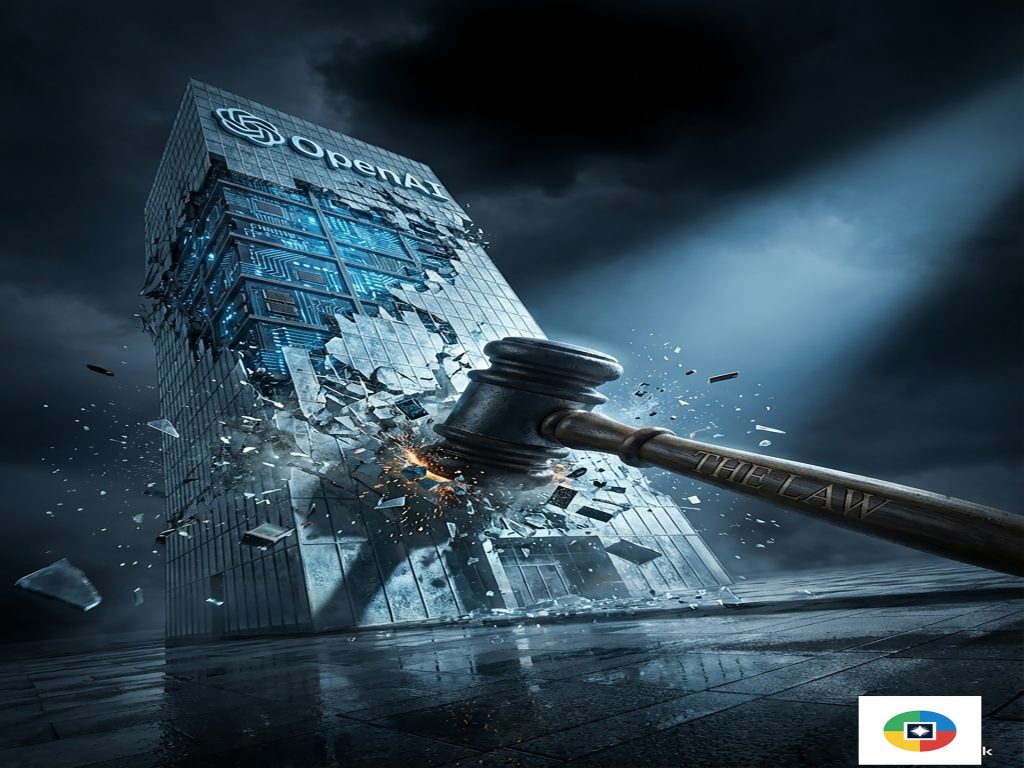
This analysis reveals OpenAI’s “Balance Sheet” lies in ruins.This is no longer a commercial dispute; it is the trial of the century regarding tech ethics and capital greed. Musk’s $134 billion claim is a sledgehammer smashing the Silicon Valley ethos of “Move fast and break things.”
It tells the world: Original intent has a price. Promises have a memory.
For OpenAI, the April trial is Judgment Day.
- If they fight, they face public scrutiny of their moral failings.
- If they settle, they face financial ruin and strategic capitulation.
In 2015, when Musk and Altman toasted to a future of AI for humanity, they never imagined they would fight for custody of that future in a courtroom decade later.
The auditor of this balance sheet is not a Big Four firm; it is History. And history’s verdict is often colder than the law.


