
The Great AI Power War: Why Nuclear Plants Are the New GPUs
Have you noticed something deeply unusual?
At the start of 2026, the tech titans of Silicon Valley stopped talking exclusively about the parameter counts of large language models, inference costs, or the latest AI applications. Their CEOs began appearing with increasing frequency at an entirely different kind of negotiation: the bargaining table for nuclear power plants.
In January, Meta announced it had signed agreements securing up to 6.6 gigawatts of nuclear power capacity. To put that in perspective, 6.6 gigawatts is equivalent to the output of six large-scale nuclear power plants. Microsoft, Amazon, and Google quickly followed suit, scouring the globe for stable sources of clean energy.
At the same time, another development was even more alarming.
In July 2024, in Virginia—the state with the densest concentration of data centers in the United States—approximately 70 data centers simultaneously disconnected from the main power grid due to a high-voltage transmission line fault, switching to their backup power systems. Less than a year later, it happened again: another 40 data centers collectively “islanded” themselves from the grid.
A senior executive at PJM Interconnection, the largest grid operator in the U.S., made a remark that has since become a chilling refrain: “What would happen if the reduction reached 3,000 or 5,000 megawatts?”
Behind that question lies a harsh, approaching reality: the AI computing power arms race is colliding with the physical world’s ceiling. And that ceiling is not chip manufacturing process nodes, nor is it algorithmic innovation. It is something far more fundamental, far older, and far less glamorous: electricity.
In a blog post in March 2026, NVIDIA CEO Jensen Huang defined energy as the “first principle” of the AI industry. “Real-time generation of intelligence requires real-time generation of electricity,” he wrote. “Every token generated is the result of electrons moving, heat being managed, and energy being converted into computing power.”
This is a clear-eyed recognition. But what Huang did not say is this: a first principle is not a starting point. It is a boundary. A boundary does not tell you where to begin. It tells you where you must stop.
So where is this boundary? Why have the tech giants suddenly pivoted to securing energy resources? Is the end point of computing power truly the electrical transformer?
This might sound abstract. Let me offer an analogy.
Imagine AI as a colossal factory. The raw material for this factory is not iron ore or petroleum. It is electricity. The factory’s production line consists of hundreds of thousands of GPU chips. Its final product is intelligence—intelligence in the form of tokens.
How much electricity does this factory consume? A single 1-gigawatt data center will incur electricity costs of $2.75 billion over a four-year period. That is a staggering figure by any industrial standard. More importantly, data from the International Energy Agency indicates that global data center electricity consumption is projected to exceed 1,000 terawatt-hours in 2026—equivalent to the annual electricity usage of Japan.
Do you see the counterintuitive logic emerging?
For the past two decades, we have operated under a comforting illusion: the internet is virtual, infinite, and unconstrained by physical limits. The world of bits could be replicated endlessly, at near-zero marginal cost, expanding without bound. AI has punctured that bubble. When every bit generated requires the consumption of tangible watts, the digital world can no longer exist independently of the physical.
The digital economy is returning to the discipline of watts, after a long detour through the carnival of bits.
From an economic perspective, we can view AI output as a “commodity of intelligence.” Its production function includes labor (algorithm engineers), capital (GPU clusters), and energy. And energy is the most critical input.
This introduces the concept of a “factor bottleneck.” Imagine a barrel. The amount of water it can hold is not determined by its longest stave, but by its shortest.
Huang’s blog post stated the matter bluntly: “Energy supply has become a critical bottleneck to scaling AI.” This is not hyperbole. Starting in the second half of 2025, several regions in the U.S. experienced frequent power outages driven by surging AI computing demand. Microsoft CEO Satya Nadella admitted in a podcast that the company faced an unprecedented predicament: “We have piles of GPUs, but they are sitting idle because we lack the electricity and the space.”
This is a deeply abnormal signal. Under normal business logic, possessing the world’s most sought-after GPUs—the hard currency of just a year ago—would mean running production at full capacity to reap supernormal profits. But now, progress is being choked by the most basic element: electricity.
And the bottleneck is even more mundane and fundamental than most people realize.
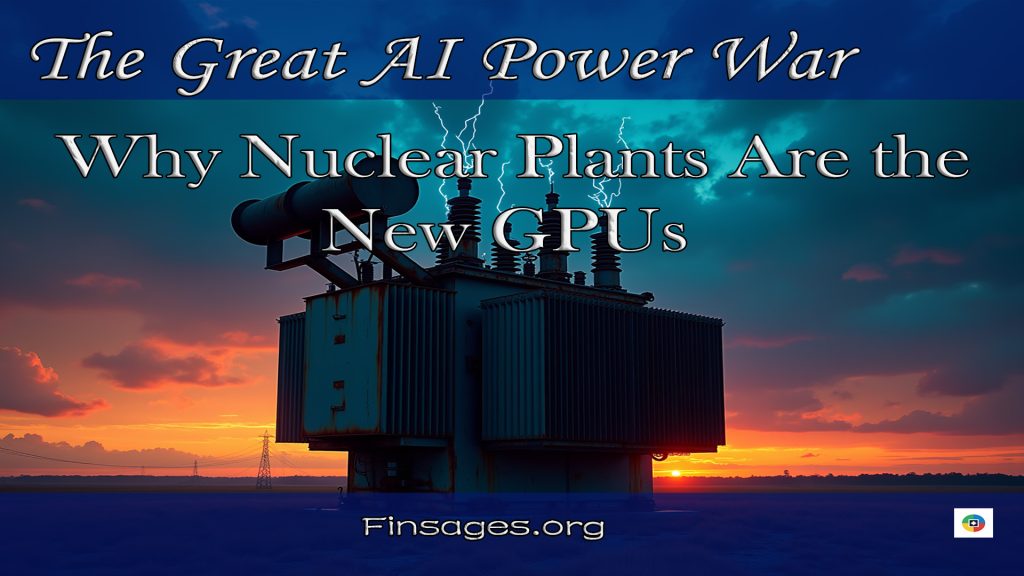
The endpoint of computing power is not the chip’s process node. It is the transformer’s capacity.
Why the transformer? Because it is the “faucet” of the power system. Without it, even the most abundant power plants cannot deliver a single watt to the end user. In the United States, transformers are facing a severe crisis. The American Society of Civil Engineers rates the overall U.S. power grid a C-minus. Seventy percent of the nation’s power transformers have exceeded their 25-year design life. Meanwhile, lead times for new transformers have stretched from a normal 50 weeks to over 120 weeks, with a supply gap of 30 percent.
This creates a deadlock. AI requires massive amounts of electricity. Electricity requires a grid to transport it. The grid requires transformers to function. And transformer production cannot keep up. Faced with this, the tech giants have been forced to find alternative paths: buying power plants themselves, building their own grids, and solving the “last mile” of power supply on their own.
This is why Meta, Microsoft, and Amazon are all competing for nuclear power assets. Not because they want to become energy companies. But because without doing so, their computing power ambitions simply cannot be realized.
To be honest, seeing this shift made me catch my breath.
I spent thirty years in banking risk management, reviewing tens of thousands of companies. I have seen countless businesses that soared on the latest trends, only to be shattered by a single fundamental flaw. Not a bad product. Not a weak team. But a breakdown in the most unglamorous link in their supply chain.
The AI industry is now facing precisely this problem. Its Achilles’ heel is not algorithms or chips. It is the transformer.
Let’s focus on Virginia, on the East Coast of the United States. This region is known as “Data Center Alley,” through which nearly 70 percent of the world’s internet traffic once flowed.
The “grid-islanding” event in July 2024 saw about 70 data centers simultaneously disconnect from the main grid. This was not a drill; it was a real crisis. Less than a year later, it happened again with another 40 data centers.
In both instances, the reduction in power demand was less than 2,000 megawatts, not enough to trigger a systemic crisis. But the words of the PJM executive capture the underlying dread: “What would happen if the reduction reached 3,000 or 5,000 megawatts?”
The unspoken implication is this: when hundreds of data centers simultaneously disconnect, the grid faces an extreme reversal from “overload” to “sudden drop.” This bidirectional shock is far more dangerous than load growth in a single direction.
Data confirms the escalating risk. By 2030, data centers could account for as much as 57 percent of Virginia’s total electricity consumption. Nationwide, data centers could consume up to 17 percent of all U.S. electricity, up from just 4 to 5 percent today.
What does this mean? It means the U.S. grid is being asked to carry a load pattern it was never designed for—not the steady demand of industrial facilities, not the predictable cycles of residential use, but the volatile, algorithm-driven, pulsed demand of AI computing, with the potential to “jump off” the grid at any moment.
Why is the world’s most advanced economy facing such a fundamental electricity bottleneck in the 2020s? The answer lies in three characteristics: old, fragmented, and slow.
First, “old.” The U.S. power grid is a machine that has been running for nearly a century. Seventy percent of its transformers are beyond their 25-year design life. Thirty-one percent of transmission equipment and 46 percent of distribution equipment are operating past their intended lifespan. This is not a problem isolated to one state; it is systemic, nationwide aging.
Second, “fragmented.” The U.S. does not have a single grid. It has three—the Eastern, Western, and Texas interconnections—that operate largely independently of one another. This fragmentation, combined with the complex division of authority between state and federal governments, turns grid upgrades into a political and economic deadlock, with endless arguments over “who pays.”
Third, “slow.” The approval process for connecting a new data center to the grid typically takes three to five years. In some regions, it can stretch to eight years. In Texas, as of the end of 2025, the grid operator ERCOT had received requests for large-load connections totaling 226 gigawatts, most from data center developers. That is three times the state’s current data center capacity. When will these requests be approved? No one can say with certainty.
Faced with this impasse, the tech giants have only one option: do it themselves.
Meta’s nuclear procurement agreements are not simple power purchase contracts. They represent a carefully orchestrated energy strategy. At their core are SMRs—small modular reactors. A single SMR module can provide tens to hundreds of megawatts of power, enough to support a large data center. Multiple modules can be installed in parallel, scaling capacity as needed. Most importantly, SMRs can be built adjacent to data centers, eliminating dependence on long-distance transmission.
The logic was succinctly stated by Sam Altman, whose company Oklo was one of Meta’s partners: “Fission is a key solution to the growing energy demands of AI.”
If nuclear plants represent a long-term solution, transformers are an immediate priority. The U.S. relies on imports for 80 percent of its large power transformers, and the global supply chain is tightening. Global average transformer prices have risen more than 60 percent since 2020.
In this global scramble, Chinese companies have emerged as pivotal players. China currently accounts for about 60 percent of global transformer production capacity. While lead times for U.S.-based suppliers can stretch to 100 weeks, Chinese manufacturers, with their mature skilled workforce and complete industrial chain, can deliver custom products in as little as 12 weeks.
In the first eight months of 2025, China’s transformer exports reached 29.7 billion yuan. Exports to Europe surged by over 138 percent. European clients are willing to pay a 20 percent premium just to secure supply.
This is a dramatic reversal. In the 1980s, China’s 500-kilovolt transformers were still playing a backup role to Japanese equipment. Today, China has built the world’s only commercially operational ultra-high-voltage (UHV) grid, with over 40,000 kilometers of UHV direct current transmission lines in operation.
“What would happen if the reduction reached 3,000 or 5,000 megawatts?” That question remains unanswered. But one thing is certain: the aging, fragmented, and slow U.S. power grid has become the greatest Achilles’ heel of the AI industry.
While America’s tech giants scramble for nuclear plants and struggle with grid bottlenecks, on the western shore of the Pacific, a very different strategy is unfolding.
In March 2026, the third Qinghai Green Computing Power Industry Development Promotion Conference was held as scheduled. The Party Secretary of Qinghai province made a telling remark: “The exponential growth in token usage is activating unprecedented new demand for computing power, creating a major strategic opportunity for the coordinated development of green electricity and computing power.”
“Coordinated development of electricity and computing”—or “computing-power synergy”—is China’s answer.
Behind this term lies a fundamental strategic concept: actively steering demand for computing power toward regions rich in electricity resources, letting “bits” travel to “watts,” rather than having “watts” perpetually chasing after “bits.”
In western China, from Inner Mongolia to Qinghai, from Gansu to Ningxia, a “computing corridor” stretching thousands of kilometers is taking shape. This region is endowed with the nation’s richest wind, solar, and hydroelectric resources. Its cool climate and clean air provide the lowest possible “natural air conditioning” for data centers.
Meanwhile, on the eastern seaboard, the computing power demand in megacities like Beijing, Shanghai, Guangzhou, Shenzhen, and Hangzhou continues to explode, while land, electricity, and energy consumption quotas are approaching their limits. This tension lies at the heart of China’s computing power strategy. Its resolution is “Eastern Data, Western Computing.”
In 2022, China launched the “Eastern Data, Western Computing” project at the national level. By March 2026, the Helinger New Area in Inner Mongolia had already hosted 50 computing center projects. The region’s total computing capacity reached 280,000 petaflops, and the green electricity usage rate of operational data centers exceeded 86 percent.
To put that in perspective, it means that in Inner Mongolia, 86 percent of the electricity driving AI computing comes from wind, solar, or hydro sources. In Virginia’s Data Center Alley, that figure is less than 30 percent.
Why can China pursue this path, while the U.S. struggles? The answer lies in three fundamental differences.
First difference: one grid. The U.S. has three largely independent grids. China has a single grid—operated by the State Grid Corporation of China and China Southern Power Grid—with unified planning, unified dispatch, and unified standards.
The power of this “one grid” was demonstrated again in the spring of 2026. In March, the Shaanxi-Henan UHV DC transmission project was approved, and construction began the same day on the Panxi UHV AC project. The combined investment for these two projects is approximately 42.2 billion yuan.
This is just the beginning. State Grid plans to invest 4 trillion yuan during the 15th Five-Year Plan period (2026-2030), a 40 percent increase over the 14th Five-Year Plan. This investment will be directed toward increasing inter-provincial and inter-regional transmission capacity by more than 30 percent, building the backbone for “Eastern Data, Western Computing” and “computing-power synergy.”
Second difference: top-level design. The U.S. tech giants’ scramble is a reactive “self-rescue” measure—the grid couldn’t keep up, so they were forced to buy power plants. China’s “computing-power synergy” is a proactive, nationally coordinated strategy, aligning computing power deployment with energy resource distribution.
In 2026, “computing-power synergy” was included for the first time in China’s Government Work Report, designating it as a new infrastructure initiative. The Outline of the 15th Five-Year Plan explicitly calls for promoting the coordinated layout of green electricity and computing power. This is not a technical concept; it is a national strategy.
Third difference: a complete industrial chain. The U.S. imports 80 percent of its large transformers. China is the only country in the world with a fully integrated transformer industrial chain—from grain-oriented silicon steel smelting to electromagnetic wire processing, from core manufacturing to final assembly. The entire production process can be completed within a 300-kilometer radius. Raw material procurement takes just seven days; for European or American companies, the logistics for raw materials alone can take two months.
This is not an accident. It is the result of decades of industrial accumulation.
China’s transformer industry output exceeded 300 billion yuan in 2025, accounting for over 50 percent of global production. Transformer exports reached 64.6 billion yuan in 2025, a year-on-year increase of nearly 36 percent.
This is China’s “difference”: one grid for unified dispatch, top-level design for strategic coherence, and a complete industrial chain forming a closed loop. These three elements constitute China’s foundation for addressing the AI energy challenge.
In this global battle for power, one piece of equipment has become a true strategic asset: the transformer.
Why the transformer? Because it is the “faucet” of the power system. Without it, the most abundant power plants cannot deliver a single watt. Without it, the largest data centers cannot connect to the grid.
The International Energy Agency projects that global data center electricity consumption will exceed 1,300 terawatt-hours by 2030, approaching Japan’s total annual consumption. The global transformer supply gap is currently 30 percent, and the shortage is expected to persist until around 2030.
Who is filling this gap? The answer is China.
China is now the world’s largest transformer producer, accounting for about 60 percent of global capacity. In 2025, China’s transformer industry output exceeded 300 billion yuan, with production accounting for more than 50 percent of the global total. In 2024, China updated its mandatory national standards for transformer energy efficiency for the fourth time, with the Grade 1 efficiency metrics reaching international leadership levels.
In March 2026, four central government ministries jointly issued the “Implementation Plan for High-Quality Development of Energy-Efficient Equipment (2026-2028),” setting a target that by 2028, more than 75 percent of newly added transformers will be high-efficiency models, and high-efficiency transformers in service will account for 15 percent of the total.
What does this mean? It means transformers are not just a strategic asset—they are a green strategic asset. In the coming years, the penetration rate of high-efficiency transformers is expected to jump from less than 10 percent today to 75 percent. That is a leap in orders of magnitude.
The transformer is transforming from a “traditional industrial product” into the “faucet of the digital age.” Without it, computing power is just a spinning turbine with no output.
If the transformer is the bottleneck for electricity, then liquid cooling is the bottleneck for heat.
The power density per rack in AI data centers has already surged from 5-10 kilowatts to 50-100 kilowatts. To grasp the scale, consider that one rack now generates heat equivalent to dozens of homes simultaneously. Traditional air cooling can no longer meet the cooling demands of such density.
NVIDIA’s next-generation AI computing platform, the Rubin NVL72 system, is designed with 100 percent liquid cooling, setting a new industry benchmark. At the same time, under the macro-level policy framework of “peak carbon and carbon neutrality,” government regulators are imposing increasingly stringent requirements on data center Power Usage Effectiveness (PUE), mandating that new and expanded large and ultra-large data centers achieve a PUE below 1.25. Liquid cooling, as the key technology for reducing PUE, has gained strong policy tailwinds.
The liquid cooling value chain is being reshaped. Taking the NVIDIA GB300 liquid-cooled rack as an example, the four core components—cold plates, the Cooling Distribution Unit (CDU), quick disconnects (UQD), and manifolds—account for the highest value. Average gross margins in this sector are above 25-30 percent, and for some components with higher technological barriers, margins can reach 40-60 percent.
More importantly, NVIDIA has opened up its GB300 liquid cooling supply chain, and Google has adopted a direct procurement model for its TPU racks. This presents a strategic opportunity for Chinese manufacturers to directly plug into the global supply chains of leading tech companies. Chinese liquid cooling companies are transitioning from “component suppliers” to “core partners.”
Liquid cooling is emerging as another “water seller” in the computing power war. Its value is likely underestimated by most observers.
When we shift our focus from AI applications to the underlying infrastructure, a clear logic emerges: the computing power war will not be won by whoever has the most advanced algorithms, but by whoever has the most stable electricity supply; not by whoever has the most GPUs, but by whoever has the most robust transformers; not by whoever moves the fastest, but by whoever builds the deepest foundations.
This is the application of the “bucket theory” to the AI era. For the past few years, the shortest plank in the AI industry was the chip. NVIDIA’s GPUs were the hardest currency. But the reality of 2026 tells us that the bottleneck is shifting. Chips remain scarce, but the real choke point is no longer the manufacturing process node. It is transformer capacity, grid load, and cooling capabilities—the most fundamental, oldest, and least glamorous physical infrastructure.
When the “shortest plank” of an industry shifts from chips to transformers, the direction of investment must shift as well.
In economics, this is the “factor bottleneck effect.” When the supply of a factor becomes rigid, no amount of additional capital or labor can increase output beyond the limit set by that factor. When everyone needs transformers, and there are simply not enough transformers to go around, the price is set by whoever is willing to pay the most. This is not free competition; it is an auction.
History has seen this pattern before. Around 2008, the shale oil revolution began. Hydraulic fracturing, or fracking, was the key technology. As production exploded, a bottleneck quickly emerged: fracking pumps. For a time, only a handful of companies globally could produce the high-pressure pumps needed. Their profits soared, and during the subsequent oil price crash, these “pick and shovel” companies continued to do well. Why? Because whether oil prices were high or low, as long as shale oil was being extracted, the pumps were essential. They were the “shovel sellers,” not the “gold miners.”
The same logic is now playing out in the AI industry.
In this AI gold rush, the ultimate winners may not be the “gold miners”—the AI application companies—but the “shovel sellers”: the companies providing electricity, transformers, cooling equipment, and grid services.
I wrote about this logic in my book, “The Engine of History.” Each major technological revolution is first ignited by innovators. It then hits the wall of infrastructure bottlenecks. And then, during the subsequent period of infrastructure catch-up, a golden age emerges for the “water sellers.”
The golden age of the first industrial revolution was not Watt’s steam engine company, but the coal mine owners and railway barons. The golden age of the second industrial revolution was not Edison’s General Electric, but the grid operators and transformer manufacturers.
What about this revolution?
While the U.S. tech giants are scrambling frantically for nuclear plants, China’s response appears far more deliberate. This is not because China faces no pressure—data centers already account for about 2 percent of China’s total electricity consumption, and that share is rising rapidly. It is because China has prepared: from “Eastern Data, Western Computing” to “computing-power synergy,” from the UHV grid to the complete transformer industrial chain. This is a chess game that has been in the making for years.
Sun Tzu’s “The Art of War” states: “The skillful strategist puts himself in a position where defeat is impossible and does not miss the opportunity to defeat the enemy.” [Note: This echoes a core principle from Sunzi Bingfa (The Art of War), emphasizing the importance of establishing an unassailable position before engaging.] China’s “computing-power synergy” strategy is essentially a move to establish an unassailable position: using the green electricity of the west to power the computing needs of the east; using top-level design to address market failures; using the advantage of a complete industrial chain to fill global gaps.
In this AI-driven energy war, victory may not be determined by chip process nodes, but by grid density; not by algorithmic breakthroughs, but by transformer production capacity; not by the speed of innovation in Silicon Valley, but by the industrial depth of a nation.
Let us return to the opening of this piece.
At the start of 2026, Silicon Valley’s tech titans stopped talking exclusively about algorithms. They fanned out across the globe to bid on nuclear power plants, to acquire shuttered coal-fired facilities, to secure those seemingly bulky, utterly unglamorous devices: transformers. Five years ago, this scene would have seemed absurd. Today, it is the new normal.
Why? Because the “first principle” of AI is being redefined. We once thought the first principle was algorithms, computing power, data. But Jensen Huang was right: the first principle is energy. Behind every query you make to an AI is the flow of electrons and the dissipation of heat. Every token generated is the result of energy transformed into intelligence.
When computing power demand grows exponentially, and grid capacity expands only linearly, the ceiling of the physical world inevitably appears. This is not a failure of technology. It is a law of physics. The digital world can replicate infinitely, but watts cannot. Bits can approach zero marginal cost, but joules cannot.
This “global battle for power” is, on the surface, a competition for energy resources. At its core, it is a return to fundamentals. It reminds us that the digital economy has never truly been independent of the physical world; it merely forgot this fact for a while. Now, the physical world is asserting its presence in a way that cannot be ignored.
The ancient Chinese text, the I Ching (Zhou Yi), states: “What is above form is called the Way; what is within form is called the tool.” [Note: This is a foundational philosophical distinction in Chinese thought, between the intangible principles (Dao) and the tangible instruments (Qi) that manifest them.] In the AI era, we need both the aspiration to reach for the “Way” through breakthroughs, and the grounding to hold fast to the “tools” that form the foundation. Computing power without transformers is a castle in the air. Intelligence without a grid is water without a source.
When we speak of algorithms, models, and applications, let us not forget the foundation upon which it all rests: the oldest, most silent layer of industrial infrastructure. At the end of the digital world, we return to the physical world’s starting point.
And that starting point lies in the transformer outside your own door.
I am a Financial Veteran from Finsage. In this era of information overload and scarce truth, I want to be your companion, watching the winds of change and decoding the complex puzzles for you. If you, too, are fascinated by this great game between AI and energy, and want to understand where true value lies in the computing power war, to protect your own cognition and wealth, please follow me. Let us, together, be the ones holding torches, looking out for each other on this cold, barren wasteland of data.
This world is magnificent. Let’s meet at the summit.


