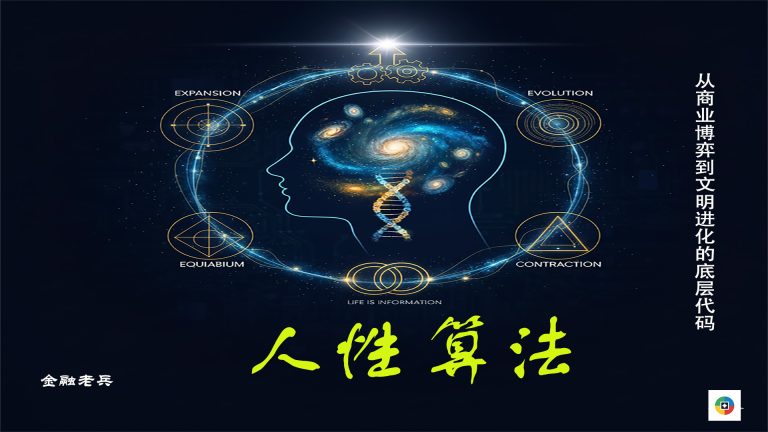
Chapter 1: The Source of the Universal Code: Reshaping the Four Forces Model from First Principles
Preface
Hello, I am the Financial Veteran from “Finsages.” As I write this preface, I invite you to join me in a thought experiment—one that is both audacious and essential. I ask you to momentarily set aside the myriad affairs of your life and recall the most critical crossroads that have defined your destiny: a career choice that caused sleepless nights, an intimate relationship that left an indelible mark, or a startup venture into which you poured your entire being.
Now, I ask you to stretch your thoughts across a grander scale of time and space. Imagine the resolve of the Roman legions crossing the Rubicon. Feel the thunderous roar of the first steam-powered piston of the Industrial Revolution. Gaze upon the crumbling of the Berlin Wall, a moment that symbolized the end of the Cold War.
Here is the ultimate question: is it possible that the hidden code driving your critical life choices is the very same code that drove the business cycles of the Industrial Revolution and the destiny of the Roman Empire?
This question has haunted me for over three decades of my career in financial risk management. It has persistently knocked on the door of my soul after I reviewed the successes and failures of tens of thousands of enterprises and personally navigated the turbulent waves of several economic cycles. In my previous works, we forged a compass called the “Four Forces Model” to measure the tides of the business world and to navigate the course of great nations through the long river of history. It seemed we had found an analytical tool powerful enough to explain the external world.
Yet, deep within, I have always sensed that this was not the final answer. The “Four Forces Model,” however sophisticated, remains a “map.” It describes and explains the “results.” What I truly seek is the invisible “hand” that draws the map, the more fundamental “genesis program” that has authored all the legends of business and the epics of history.
This book is my final answer in that quest. It is the capstone of my entire intellectual framework and my most audacious intellectual adventure to date. In this book, I will prove a thesis that may be shocking in its conclusion: The “Four Forces Model” I have proposed is not merely an analytical tool for economics or history. It is a universal “Human Algorithm,” the foundational code for understanding any complex system composed of human beings—from your every heartbeat and argument to the rise of a corporation, the collapse of an empire, and indeed, the evolution of human civilization itself.
The Expansion Force, the Contraction Force, the Balancing Force, and the Evolutionary Force—these are not subjective business metaphors I constructed. They are the four most basic, core “source codes” of humanity’s ancient operating system, traceable to the first principles of physics and biology.
I dare to propose such a paradigm-shifting thesis today because an unprecedented, game-changing “ultimate variable” has descended upon our era: Artificial General Intelligence (AGI). The advent of AGI is far more than the arrival of a smarter tool. It is akin to a “magic mirror” of incredible clarity suddenly placed before our civilization. At an astonishing speed, it is taking over all the calculable, executive tasks of “how-to,” thereby unlocking our ability to understand, and even to optimize, our own “Human Algorithm” in a way never before possible.
More importantly, this unprecedented cognitive liberation is freeing humanity from the ceaseless computation and toil for survival that has defined our existence for tens of thousands of years. Like a benevolent yet cruel deity, AGI is erasing all our excuses born of scarcity, forcing us for the first time, as a species, to collectively confront the ultimate question we have deliberately evaded: If survival itself is no longer the sole, or even primary, purpose, then what, truly, is the meaning of this brief life of ours, which is destined to return to dust?
This book will lead us to answer this question together. We will ultimately discover that, stripped of all survival anxiety, life returns to its sole and final first principle—it is a grand odyssey that exists for the sake of “experience.”
To this end, I invite you to embark on a four-part intellectual expedition with me:
In the first part, we will conduct a profound “intellectual archaeology,” returning to the first principles of physics and biology to find the ancient “genesis code” of this “Human Algorithm.”
In the second part, we will, like a rigorous physicist, test the “universality” of this algorithm, observing how it drives everything with astonishing isomorphism across four scales: the individual, relationships, organizations, and civilization.
In the third part, we will focus on AGI as the “singularity of the algorithm,” examining how it fundamentally changes our algorithm’s operating environment and ultimately leads us back to the essence of “life as experience.”
In the final part, the destination of this book, we will collectively explore how, in this new era, we can “awaken” and proactively become the “composers” of our own “Human Algorithm,” creating more profound, harmonious, and resonant experiences for this finite journey of life.
This is not just a book that explains the world, but a “new era survival guide” that helps us rediscover the meaning of life and find our place in the age of AGI. It is my most sincere, in-depth, and hopeful reflection to date.
Now, let us calibrate our compass. Let us uncover this hidden code. Let us begin this greatest of inward expeditions—a journey through physics, life, and the mind, to rewrite our own destiny.
Part One: The Origin of the Algorithm: The Four Primal Codes as Human Instinct
Before we embark on our ultimate intellectual expedition, we must first complete a thorough “purification” and “return.” In past works, we held the “Four Forces Compass” while touring the clamorous battlefields of business and the magnificent ruins of history. We used it to dissect the fabric of organizations and measure the fortunes of empires. However, that compass was always pointed toward the world of “man,” its calibrations ultimately drawn in the language of socioeconomics. Now, to seek the “foundational code” that drives everything, we must temporarily bid farewell to the familiar worlds and conduct a more profound, more essential “intellectual archaeology.”
We will no longer play the role of economists or historians, but will instead transform into rigorous “intellectual archaeologists” who transcend disciplinary boundaries. Our task is to take the “Four Forces Model,” this piece of “amber” seemingly shaped by the social sciences, and strip away its outer layers, one by one, to penetrate to its innermost, most crystalline core, searching for the most ancient “genesis genes” sealed within.
This archaeology will be a thorough “journey to the roots.” We will temporarily set aside all the complex cases of corporate strategy and geopolitics and thrust our probe directly into the older, harder strata—the universal laws of physics, the survival instincts of biology, and the inner impulses of psychology.
On this journey, we will prove irrefutably that the Expansion Force, the Contraction Force, the Balancing Force, and the Evolutionary Force—these four fundamental powers that govern the human world—are not subjective “constructs” or elegant “metaphors” that we have summarized from observation. They are an objective “discovery,” one that existed prior to human society.
The success of this part will provide the most solid and unshakable “Archimedean point” for all subsequent arguments in this book. It will elevate the thesis of the “Human Algorithm” from merely an inspiring “insight” into a “quasi-axiom” with profound explanatory power that can be repeatedly verified. Now, let us take up our intellectual scalpels and begin this excavation toward the source of all things.
Chapter One: The Source of the Universal Code: Reshaping the Four Forces Model from First Principles
The core mission of this chapter is to complete a thorough “intellectual return to the source.” We will temporarily bid farewell to the Roman Forum and the garages of Silicon Valley, sealing away those familiar cases and stories in a time capsule. Our gaze will pierce through the thin topsoil of human civilization, a mere few thousand years old, to contemplate the 13.8-billion-year history of cosmic evolution that has driven both the living and non-living worlds.
On this journey of returning to simplicity, we will map a complete “genetic profile” for each of the “Four Forces.” We will trace how the seed of the Expansion Force was sown in the form of “negative entropy” at the singularity of the Big Bang; how the fate of the Contraction Force was etched as the inescapable end for all things by the Second Law of Thermodynamics. We will see how the wisdom of the Balancing Force has long been embodied in the harmony of planetary orbits and the homeostasis of living organisms; and how the code of the Evolutionary Force, at the edge of chaos, has given rise to all the complex and beautiful miracles, from galaxies to life.
This is a foundational journey to find the “genesis code” for our entire intellectual system. Only by completing this search for our roots can we, in the subsequent chapters, proclaim the universality of this algorithm with irrefutable confidence.
Section 1: The Expansion Force: The Infinite Desire Originating from the “Negative Entropy” Instinct
I. Physics Roots: Life as a “Negative Entropy” Miracle in the Universe
(A) The Second Law of Thermodynamics: The Irreversible “Entropy Increase” Torrent of the Universe
To understand why life must “expand,” we must first understand the most fundamental, most relentless, and most irreversible “default setting” of the universe we inhabit. This default setting is governed by a law that scientists consider to be the most depressing and philosophically profound in all of physics; some have even called it “the ultimate judgment of the universe.” This is the Second Law of Thermodynamics, also known as the “Law of Entropy Increase.”
This is not a purely intellectual game born in an ivory tower. Its genesis is steeped in the coarse and heavy atmosphere of the nineteenth-century Industrial Revolution, an era defined by coal, steam, and steel—an age of power and clamor. The great steam engines, like the iron hearts of that era, powered the factories, the roaring trains, and the ocean-faring ships. The central question for all engineers and physicists revolved around a single, utilitarian goal: how to make this “heart” beat more efficiently? How to convert less coal into more powerful mechanical work to drive the pistons?
It was in this ultimate quest for “efficiency” that a brilliant young French engineer who died young, Sadi Carnot, in his small booklet titled Reflections on the Motive Power of Fire 【Note: Published by Nicolas Léonard Sadi Carnot in 1824, it is widely recognized as one of the foundational works of thermodynamics】, first touched the edge of this cosmic secret. He revealed that heat always flows spontaneously from hotter objects to colder ones. This is the most primitive and classic expression of the law of entropy increase. A cup of scalding coffee, if left in a room, will eventually cool down to room temperature. The heat it contains will evenly and irreversibly dissipate into the air molecules of the entire room, and the reverse process—the heat from the surrounding air spontaneously gathering to reheat the cooled coffee—will never occur.
Behind this seemingly mundane observation lies a profound philosophical truth about “time.” Before this, in the world of Newtonian classical mechanics, time had no “direction.” The trajectory of a planet, whether played forward or in reverse, equally conformed to the laws of physics. However, the law of entropy increase, for the first time, set an irreversible “arrow” for the universe’s time. This arrow always points in the direction of “energy dissipation” and “order disintegration.” A shattered mirror cannot spontaneously reassemble; a drop of ink in clear water cannot regroup. The past and the future, from then on, had a physically unambiguous distinction.
The one who elevated this law from an engineering principle about “heat flow” to a philosophical iron rule of cosmic universality was a German physicist named Rudolf Clausius 【Note: Rudolf Clausius, a 19th-century German physicist and mathematician, was one of the main founders of thermodynamics. He was the first to clearly formulate the concept of the Second Law of Thermodynamics and introduced the concept of “entropy”】. It was he who, in 1865, first coined the term “Entropy” and, in a language that was almost oracular in its concise and cold finality, made the ultimate proclamation for this law: “The energy of the universe is constant; the entropy of the universe tends to a maximum.”
This proclamation was like a decree of “ultimate destruction” signed by God in the cosmic genesis code. It means that our universe, initiated by the Big Bang and filled with incandescent energy and brilliant stars, has an unavoidable end: a state of absolute equilibrium, an eternal “stillness,” where all energy is uniformly distributed, all temperature differences have vanished, and all magnificent structures (from galaxies to life) have completely disintegrated. Physicists have given this endpoint an equally somber name—”Heat Death.” In that state, stars will no longer burn, life will no longer be born, and time itself will seem to lose all meaning.
However, the story is far from over. If Carnot and Clausius were the “scriptwriters” of this grand tragedy, then the one who truly “visualized” the tragic nature of this play in the most direct and shocking way was a legendary and tragic Austrian physicist named Ludwig Boltzmann 【Note: Ludwig Boltzmann, a 19th-century Austrian physicist and a founder of statistical mechanics, connected the concept of entropy with the probability of microscopic particle states, proposing the famous Boltzmann entropy formula】.
Boltzmann, with a stroke of genius, connected “entropy” to a more fundamental concept closer to our daily experience: “probability” and “possibility.” He invites us to conduct a simple thought experiment: imagine a box with ten white balls and ten black balls. In the initial state, we deliberately place all the white balls on the left and all the black balls on the right. This is a highly “ordered,” low-“entropy” state. Now, we begin to shake the box frantically. In the end, when we open it, what we will almost certainly see is a chaotic, “disordered” state where the black and white balls are uniformly mixed.
Why? Boltzmann’s answer strikes at the core: because the number of “possibilities” for the “disordered” state is orders of magnitude greater than that for the “ordered” state. Among all possible arrangements of the balls, the highly ordered state of “ten white on the left, ten black on the right” is just one out of billions of possibilities. The “disordered” state of “mixed black and white” encompasses almost all other possibilities. Therefore, as the system moves randomly, it naturally tends toward the state of “maximum probability”—that is, the most “chaotic” state.
This is the most profound and chilling explanation of the law of entropy increase. The reason the universe irreversibly moves toward “disorder” is not due to some mysterious, active force of “destruction.” On the contrary, it is simply because “disorder” is the most “lazy,” most “mediocre,” and most “probable” fate of the universe. The reason a meticulously organized and tidy study inevitably becomes messier over time is not because of a “god of messiness” who specializes in destruction, but simply because the number of possible combinations for a “messy” state far exceeds that of a “tidy” state.
This irresistible cosmic torrent rushing toward “disorder” is the darkest and heaviest “backdrop” for our understanding of all life phenomena, especially the origin of the “Expansion Force.” It acts like a cosmic “gravity,” constantly trying to tear apart and flatten all complex, ordered structures, returning them to the primordial, uniform state of “chaos.”
The Tang dynasty poet Du Fu, looking out from a high place, once wrote the immortal lines, “The boundless forest sheds its leaves shower by shower; the endless river rolls its waves hour by hour.” In its original Chinese, this couplet evokes a profound sense of grand, inevitable decay driven by the relentless passage of time—a perfect literary portrayal of this cosmic torrent. The “shedding leaves” symbolize the inevitable decay and withering of individual ordered structures, while the “rolling river” symbolizes the relentless flow of “time” and “entropy increase” that drives everything toward the ultimate sea of “Heat Death.”
Therefore, when we speak of “expansion,” we are not talking about an easy, matter-of-course choice. On the contrary, it is an extremely “anomalous” act, a costly, partial, and temporary “rebellion” against the most fundamental law of the universe. In the next unit, we will see that life, the most incredible miracle in the universe, is, in its very essence, a glorious yet fragile “island of negative entropy,” striving to expand its own boundaries in this dark ocean of “entropy increase” that rushes toward Nirvana’ or ultimate ‘extinction of life’.
(B) The Definition of Life: A Local, Temporary “Negative Entropy” Island
In that irresistible cosmic torrent rushing toward “Heat Death,” are there any exceptions? Is there some “privileged force” that can openly “defy” the law of entropy increase? This question long haunted the intellectual halls of physicists like a specter. And the one who finally cleared this fog for us, providing the most profound and awe-inspiring physical definition for “life,” the most magical phenomenon in the universe, was not a biologist, but a founder of quantum mechanics, a great physicist full of philosophical contemplation—Erwin Schrödinger 【Note: Erwin Schrödinger, a renowned Austrian physicist and one of the founders of quantum mechanics, was awarded the 1933 Nobel Prize in Physics for developing the Schrödinger equation, which describes the motion of microscopic particles.】.
Let’s engage in a “historical documentary-style” scene reconstruction, turning the clock back to the winter of 1943. It was a time when human civilization itself was undergoing its most brutal “entropy increase”—the flames of World War II were tearing apart and destroying the order and civilization of the European continent with unprecedented intensity, turning it into a scorched earth of ruins. Yet, amidst this darkness, at Trinity College Dublin in a still-neutral Ireland, the nearly sixty-year-old Schrödinger, facing an auditorium packed with listeners, began a series of public lectures that would later be recorded in the annals of history, titled “What Is Life?”
In an era when the physical world was disintegrating, a physicist turned his most profound gaze toward the most fundamental and eternal ultimate question of “life.” This scene itself is filled with a moving, symbolic meaning of resistance against chaos. And in these lectures, Schrödinger, with a brilliant, discipline-transcending insight, revealed a groundbreaking secret to us: life is not a “violator” of the law of entropy increase; on the contrary, it is a “top-tier player” that “utilizes” and even “plays with” this law on a much deeper level.
Schrödinger invites us to imagine a living organism—a cat, a tree, or even ourselves—as a physical system. What is its most prominent feature? Not its material composition—the atoms that make us up are no different in essence from the atoms that make up a rock. Its most prominent feature is its highly complex, incredibly “ordered” internal structure. From the tens of thousands of protein molecules operating like a precision factory inside a single cell, to the perfectly coordinated complex structure of an entire organ, to a brain possessing thought and consciousness. Life is a “miracle of order.”
However, according to the law of entropy increase we discussed earlier, the internal order of any isolated physical system must spontaneously and irreversibly move toward disintegration. So, how can this highly ordered system of life, over the course of a lifetime (at least before adulthood), not only avoid becoming more disordered but actually maintain and even develop a higher degree of order (for example, growing from a fertilized egg into a complex human being)?
Schrödinger’s answer, like a Zen master’s “katsu,” strikes at the very essence. He pointed out that our confusion arises because we mistakenly view a living organism as an “isolated system.” The entire secret of life lies precisely in the fact that it is an “open system.” The only way it can counteract its own internal “entropy increase” is by continuously and persistently drawing “order” from its external environment to compensate for and offset its own internal “decay.” To more clearly describe this exchange of “order,” Schrödinger coined an incredibly elegant and inspiring concept—”Negative Entropy.”
He declared that the only sustenance a living organism relies on is “negative entropy.” We stay alive by constantly “eating” negative entropy 【Note: The content of these lectures was later compiled into a book published in 1944, commonly translated as What Is Life?. This book profoundly influenced the later development of molecular biology. Both James Watson and Francis Crick stated that it was a key source of inspiration for their discovery of the DNA double helix structure.】. This might sound a bit esoteric. But when we translate it into everyday language, the process is something each of us practices every single day.
When we eat an apple, what are we “eating”? From a physics perspective, the apple is a highly ordered, “low-entropy” system rich in chemical energy and complex molecular structures. Our body, through metabolism, “breaks down” the ordered structure of the apple, extracts the energy we need to build and repair our own, more complex ordered structures (like cells and tissues), and then expels the unneeded, simple, disordered “waste” (like carbon dioxide, water, and heat) into the environment.
See, the essence of this process is a delicate “entropy exchange.” We ingest a “low-entropy” apple from the environment and discharge a pile of “high-entropy” waste back into it. The “entropy difference” between them is what we use to pay the expensive “life tax” required to maintain our own “low-entropy” state. Plants, through photosynthesis, play the same game. They draw highly ordered “energy packets”—photons from the sun—and simple, low-entropy inorganic substances (carbon dioxide and water) from the environment, and then synthesize them into complex, highly ordered organic matter (like glucose), radiating disordered “heat” in the process.
So, the profound meaning of Schrödinger’s statement “life feeds on negative entropy” becomes crystal clear. Life does not “defy” the Second Law of Thermodynamics, because if we consider the “living organism” and its “environment” together as a larger, isolated system, the total entropy of this larger system is still unequivocally and continuously increasing. Life is just a clever “local player” that, in an extremely ingenious way, builds its own internal “entropy decrease” on the foundation of causing a “greater entropy increase” in the external environment.
Thus, we can provide the most precise and poetic physical definition for “life”: Life is a local, temporary, glorious, yet fragile “island of order” in the vast, dark cosmic ocean governed by the law of “entropy increase” and rushing toward eternal stillness. It fiercely maintains and expands its own boundaries by continuously drawing “negative entropy” from the outside.
This definition provides the final and most solid logical singularity for understanding the physical roots of the “Expansion Force.” Because, in this tragic struggle against the cosmic torrent of entropy increase, merely “maintaining” the existing order is far from enough. The pressure of “entropy increase” from the universe, relentlessly eroding us like ceaseless waves pounding the shores of our island, constantly washes away our sand. A static “island of negative entropy” that is content with “defense” is ultimately doomed to be gradually and irreversibly consumed by these waves, eventually returning to the disordered ocean.
Therefore, the only effective survival strategy is not just to “resist” erosion, but to proactively and aggressively “expand” the boundaries of our island. A living organism must continuously draw more “negative entropy” from the environment than it needs to offset its own “decay,” and convert this “surplus” into the “growth” and “replication” of its own ordered structure. A tree must not only maintain its own survival, but it must also strive to grow new branches and leaves to occupy more space and capture more sunlight. A species must not only maintain the survival of its existing members, but it must also, through “reproduction,” create more “new islands” carrying the same ordered information, spreading the species’ “negative entropy” pattern over a wider territory.
This is the most primitive, most profound, and most heroically tragic physical origin of the “Expansion Force.” It does not stem from some high-level, metaphysical “ambition” or “desire.” It is the one and only, and most instinctive, “survival algorithm” that life, this “negative entropy” miracle of the universe, has evolved to fight against the most fundamental “fate of death” etched into the deepest cosmic laws. Expansion is not a choice, but a destiny. To not expand is to be ultimately devoured by the torrent of entropy increase.
II. Biological Embodiment: The Inherent Impulse from Cell Division to Population Expansion
(A) The “Selfishness” of Genes: The Most Fundamental Biological Code for the Expansion Force
If physics reveals the grand and tragic “external pressure” of why life “must” expand, then biology will dissect the elegant and ruthless “internal program” of “how” life expands. To find the “source code” of this program, we must shift our gaze from the macroscopic “phenomenon” of the organism, which ages and dies, through to its microscopic, nearly immortal “core.”
In this core, a maverick Oxford biologist with the spirit of a Darwinian warrior—Richard Dawkins 【Note: Richard Dawkins, a prominent British evolutionary biologist and ethologist, is one of the leading figures of neo-Darwinism】—has already found the “master key” to unlock all the mysteries of life’s expansion with his earth-shattering theory of the “selfish gene.”
In his eponymous book published in 1976, which upended the worldview of countless people 【Note: Richard Dawkins, The Selfish Gene, 1976】, Dawkins presented a groundbreaking and completely perspective-shifting thesis: in the four-billion-year history of life’s evolution, the true protagonists have never been the diverse species we can see with our naked eyes, let alone the ephemeral individual organisms. The true protagonists are the “genes,” hidden deep within each of our cells, carried by deoxyribonucleic acid (DNA), silently replicating, mutating, and competing on the stage of time. And all of us—whether human, elephant, oak tree, or blade of grass—all these magnificent and complex life forms, are nothing more than “survival machines,” meticulously crafted and used by these “genes” to replicate and pass themselves on to the next generation more efficiently and safely, machines that are ultimately destined to decay and be discarded.
This perspective is like a Copernican “heliocentric” revolution, mercilessly pulling us down from the throne of our self-assumed “center of the universe.” It tells us that we are not using genes to reproduce; on the contrary, it is the genes that are using us to achieve their one and only eternal “purpose”—to maximize their own replication at any cost.
This is the “selfish” gene. This “selfishness” is not a moral “selfishness,” but a purely descriptive, emotionless term, almost like a “physical law.” If a gene codes for a trait that gives its “survival machine” even a 0.01% higher advantage in survival and reproduction than its competitors, then after tens of thousands, or millions of generations of natural selection, that gene will inevitably spread like a virus throughout the entire gene pool of the population, becoming the “mainstream code.” Conversely, any gene that is detrimental to its own replication, no matter how full of “altruistic” spirit, will be mercilessly eliminated.
Under the reflection of this cold “gene-centric” worldview, we can instantly understand the most fundamental “biological code” that drives all living things to relentlessly expand. It is the innate, insatiable “command” of the gene, driving its “survival machine” to seize as many resources as possible, acquire as much energy as possible, and ultimately complete the mission of “replication,” all in order to triumph over other “alleles” (its competitors at the same position on a chromosome).
This set of commands is encoded with incredible sophistication into the most ancient “operating system” of every living being.
First, it manifests as the most basic impulse for “cell division.” The entire “meaning” of the existence of a simple single-celled organism, like a bacterium, is almost entirely to undergo exponential “self-replication”—one divides into two, two into four—in a nutrient-rich environment. This most primitive expansion is the most naked and pure expression of the gene’s command.
Second, in more advanced multicellular organisms, this set of commands has evolved into a more complex “metabolic” system. This system, like an efficient “resource extraction and conversion factory,” drives animals to hunt and plants to photosynthesize. Its sole “purpose” is to convert disordered, low-energy substances from the external environment into the ordered, high-energy materials needed to build and repair this “survival machine,” thereby stockpiling ample “ammunition” for the ultimate act of “replication.”
Finally, and most critically, this set of commands has evolved into an “ultimate program” called “reproduction,” filled with wonderful rituals and complex behaviors. Whether it’s the seemingly cumbersome but attractive magnificent tail of a peacock, or the brutal antler-locking battles between stags for mating rights, behind it all is the most spectacular and ruthless “proxy war” staged by the “selfish genes” to board the “Noah’s Ark” to the next generation.
Therefore, when we see a lion fighting with all its might to expand its territory for more prey; when we see a great tree striving to stretch its branches upward to compete for every precious ray of sunlight; when we see an ant colony tirelessly building a larger underground kingdom, we are no longer just seeing isolated, random biological phenomena. Through the “X-ray glasses” provided by Dawkins, what we see is the billions of identical, immortal “gene” masters within these variously shaped “survival machines,” issuing the same ancient and singular command through their respective “puppets”: “Expand! Replicate! Occupy everything!”
This is the most solid and ruthless biological root of the “Expansion Force.” It does not originate from the “will” or “choice” of the organism itself. It is a “foundational code” written into the “read-only memory” (ROM) of life, one that cannot be easily modified. This code was written by the most brutal “gene elimination tournament” that has lasted for four billion years, and its only “grammar” is survival and replication. Every one of us, from the tiniest virus to the self-proclaimed “lord of all creation,” man, is merely the latest and most complex “executor” of this ancient code.
(B) Metabolism: Drawing Energy from the Environment to Maintain and Expand Order
If the “selfish gene” is the “chief architect” and “ultimate commander” of our “survival machine,” then “metabolism” is the machine’s “power system” and “logistics department.” It is an incredibly sophisticated and busy “matter and energy conversion factory” that works day and night to provide the most basic and critical “fuel” and “ammunition” for waging the great war against “entropy increase” and achieving “expansion.”
To understand the essence of metabolism, we must return once again to the most fundamental first principle of physics regarding “negative entropy.” A living organism, as a highly ordered “island,” is constantly being eroded by the cosmic torrent of “entropy increase.” The delicate protein molecules that make up our bodies spontaneously degrade; our cell structures constantly suffer minor damages; every thought, every heartbeat, every muscle contraction consumes energy and, in the process, inevitably produces disordered “heat,” increasing our internal “entropy.”
Therefore, for a living organism to merely “maintain” its existing order and not be disintegrated by this internal force of “decay,” it must, like a nation that needs to constantly collect taxes to maintain its government’s operation, continuously draw “negative entropy” from the external environment to pay this expensive “survival tax.” And metabolism is the one and only, and most central, “fiscal system” that a living organism uses to “collect taxes.”
Let’s use our own life activities, which we are most familiar with, as an example to dissect the operation of this system.
When we feel hungry and eat an apple, we are initiating the “import” program of this system. This apple is not just a bunch of undifferentiated carbohydrates, vitamins, and water. From a physics perspective, it is a highly ordered “low-entropy energy block” rich in chemical energy, formed by plants solidifying the sun’s “negative entropy” through photosynthesis.
When this “energy block” enters our digestive system, the first “decomposition” process of the metabolic factory begins. Our teeth perform physical crushing; our stomach acid and digestive enzymes perform chemical decomposition. This process is essentially “breaking” and “dismantling” the large-molecule, complex, ordered chemical bonds inside the apple, releasing the energy stored within.
The released energy and basic “building materials” (such as amino acids and glucose) are then transported through the blood to the trillions of cells—the “production workshops”—throughout our body, entering the second and more central “synthesis” process of metabolism.
In these workshops, our cells will use the energy just extracted from the apple to do two crucial things:
First, “maintenance and repair.” They will use this energy to replace old or damaged proteins, to repair erroneous DNA fragments, and to clear out the “garbage” produced during metabolism. This is paying the most basic “survival tax,” the purpose of which is to ensure that the existing order of our “survival machine” can be maintained and not collapse too quickly due to internal “entropy increase.”
Second, and more critically, if there is a “surplus” of energy after paying the “survival tax,” then this “fiscal surplus” will be used for “expansion.” Cells will use this energy to divide, from one to two (this is particularly evident in constantly renewing tissues like our skin and blood). Muscle cells, stimulated by exercise, will synthesize more protein and become stronger. Bones will continuously extend during growth. The entire organism uses this “energy surplus” to build an “upgraded” version of itself that is larger, more complex, and more ordered than before.
Finally, after this complete cycle of “decomposition” and “synthesis,” the simple, disordered “waste” (such as carbon dioxide, water, and heat) that no longer contains usable energy is discharged into the external environment through our respiratory and excretory systems. This is the “export” program of metabolism. It ensures that the “entropy” inside our system can be effectively transferred to the external environment, thereby maintaining our own “negative entropy” state overall.
Therefore, behind metabolism, this seemingly mundane physiological activity that we perform unconsciously every day, lies an “entropy exchange” game full of wisdom and efficiency, a struggle against cosmic destiny. It perfectly validates Schrödinger’s brilliant thesis with irrefutable, material-level logic: life feeds on “negative entropy.”
And the operating efficiency of this “energy engine” also directly determines the strength and form of a species’ “Expansion Force.” On the vast African savanna, the metabolism of the grass-eating wildebeest is designed to efficiently extract nutrients from low-energy-density grass. They must spend most of their day in “low-efficiency” feeding just to survive and have the energy to run. The lion that preys on the wildebeest, however, has a metabolism designed to unleash enormous bursts of energy for the hunt and to satisfy its long-term energy needs through a single “high-efficiency” meal (consuming high-energy meat). Different metabolic strategies shape different survival modes, but the underlying “expansion” command is identical: to convert as much of the environment’s “negative entropy” as possible into the “ordered structure” of their own population.
So, the next time we feel the call of hunger and enjoy a good meal, we might try a new perspective to experience this ancient process. What we feel is not just the satisfaction of our appetite. It is an ancient “accountant,” written deep in our genes, issuing the sternest “financial warning”: “Warning! The ‘negative entropy’ reserve of this survival machine is about to be depleted! Internal entropy increase is about to exceed controllable limits! Please immediately supplement with low-entropy matter and energy from the external environment!” And our every satisfied feeling of fullness is the most reassuring “financial report” from this accountant after the “fiscal replenishment” is complete: “‘Negative entropy’ reserves have been restored to a safe level. The system has obtained sufficient energy to continue executing the ‘maintain’ and ‘expand’ commands.”
This is the essence of metabolism. It is the most fundamental and indispensable “logistics support system” for the realization of the “Expansion Force.” Without this efficient “energy engine,” any grand narrative of expansion would be water without a source, a tree without roots.
(C) Reproduction and Succession: Copying and Disseminating Its Own “Orderliness”
If “metabolism” is the relentless “logistical support” and “trench defense” waged by the “survival machine” of life to maintain the “orderliness” of itself as an individual, then “reproduction” is the most magnificent and costly “strategic offensive” launched by this machine to fulfill its ultimate mission: to transmit and disseminate the “ordered information” encoded by its genes “across generations.”
We must understand the absolute necessity of this “offensive” from the cruelest dimension of “time.” As we learned from the first principles of physics, the ultimate fate of any single, local “island of negative entropy,” no matter how powerful its internal “metabolic” engine, is to be devoured by the eternal and irreversible torrent of “entropy increase.” Aging and death are the inescapable “physical destiny” of individual life. A towering tree, no matter how much sunlight, water, and soil it has converted into its own magnificent ordered structure over centuries, will eventually decay, fall, and return to the disordered dust.
Therefore, if the victory in this great war of “life” against entropy increase were measured solely by the lifespan of an individual, it would be a hopeless war destined for defeat. However, life, or rather the “selfish gene” that drives it, has found another path to “immortality” with a grander wisdom that transcends individual life and death. That path is “reproduction.”
The essence of reproduction is not the “continuation” of individual life, but a “reboot of information” and a “passing of the torch.” It is the process of, before the old “survival machine” (the parent generation) inevitably decays and disintegrates due to the accumulation of entropy, “copying” and “transcribing” the core “blueprint information” stored in the DNA, which defines the “orderliness” of the species, in a near-perfect manner onto a brand new, extremely low-entropy “initial carrier” (the offspring) full of infinite possibilities.
This process is like a wise monarch who, sensing his own decline, does not seek the illusory “elixir of life,” but instead devotes all his energy to cultivating a young and vibrant heir, completely passing on the “scepter” and “code of law” that symbolize the kingdom’s legitimacy and wisdom into his hands. The king will die, but the kingdom’s “information” and “order” will continue on in a new living vessel.
This is the profound “anti-entropic” significance of the strategic offensive of “reproduction.” It reveals to us with irrefutable logic that for the “selfish gene,” we individuals, as its carriers doomed to die, are merely disposable “ferryboats” it uses to transport itself to the next point in time. The boat may sink, but the precious “informational cargo” it carries will reach the other shore.
And to ensure the success of this “river-crossing campaign” for “informational immortality,” the gene, that most ruthless “commander-in-chief,” has designed for us “ferryboats” an incredibly powerful and irresistible “drive system” called “desire.” Through the most ancient neural circuits in the brain associated with reward and pleasure (like the dopamine system), it has “hardwired” the purely biological act of replication, “sex,” to the most intense and yearned-for “peak experience.” The sole “purpose” of this binding is to ensure that we, the not-always-so-reliable “survival machines” who are prone to inertia and even contemplation of the “meaning of existence,” are driven by an overwhelming impulse originating from biological instinct to faithfully execute the most important “replication” command.
Whether it’s the salmon swimming upstream on their spawning journey, getting battered and bruised, and finally dying of exhaustion after completing their mission, or the male mantis being eaten headfirst by the female during mating yet still completing the final act of insemination—behind all these seemingly tragic and even cruel life phenomena is the “gene’s” underlying code ruthlessly executing its “highest priority”: the life or death of the individual is irrelevant; the transmission of information is paramount.
However, if “reproduction” were merely a monotonous, quantitative “copying” and “dissemination” of its own “orderliness,” then the breadth and depth of life’s expansion would be extremely limited. It would never be able to conquer new, harsher environments. The more intelligent expansion strategy designed by life, or rather by the “invisible hand” of evolution, is a grander, “combined arms” style of “synergistic offensive” known as “ecological succession.”
Let’s imagine a piece of “scorched earth,” completely barren after a volcanic eruption. This is a typical disordered, “high-entropy” environment. At this point, the first “pioneer troops” to arrive on the battlefield are often the “opportunists” with extremely short life cycles, strong reproductive capabilities, and low environmental requirements, such as lichens and mosses. They are the “cannon fodder” and “engineers” of this expansion campaign. With their own bodies, they begin the most primitive “negative entropy” transformation of this inorganic “scorched earth.” Their death and decomposition accumulate the first thin layer of “soil” rich in organic matter.
On this thin layer of soil, the second wave of “rapid reaction forces”—herbaceous plants—can land. They further consolidate and enrich the soil and change the local microclimate. Then, the “armored division” of shrubs begins to move in. Finally, after decades or even centuries of long “fortification,” the “ultimate main army”—tall trees that grow slowly but are extremely resilient and have the most complex structures—can rise from this once “scorched earth,” forming a stable and prosperous “climax community,” what we call a “forest.”
This magnificent “ecological succession” from lichen to forest is the ultimate wisdom and power of the “Expansion Force” demonstrated at the macroscopic level of a “community of life” that transcends a single species. It is no longer the linear “quantitative expansion” of a single species, but a multi-species, synergistic “ecosystem expansion” aimed at transforming the “environment” itself into an “ordered” state.
This is the most complete “battle map” of the “Expansion Force” at the biological level. It begins with the reproductive impulse of a microscopic, selfish “gene,” provides energy to the individual “survival machine” through the “metabolism” engine, and then disseminates the individual’s “ordered information” across generations through the “reproduction” program. Finally, in the macroscopic “ecological succession,” the expansion forces of countless species converge into a mighty torrent, collectively transforming the surface of this planet from a silent, inorganic wilderness into a “biosphere” full of green, life, and order. This is the most glorious, planet-level great victory achieved by life in this universe’s greatest “anti-entropic” war.
III. Psychological Sublimation: The Desire Engine from “Survival” to “Success”
(A) Maslow’s Hierarchy of Needs: The Expanding Ladder of Desire
When the powerful “expansion” command, originating from the instincts of physics and biology, is loaded into the unique “mental operating system” of human beings—who possess a prefrontal cortex capable of self-reflection and future planning—it no longer manifests merely as a pure, passive “stress response” for survival and reproduction. It sublimates into a more advanced, proactive, and malleable inner drive that we call “desire.”
To draw a clear and universally explanatory “topographical map” for this seemingly complex and varied stream of “desire,” we must turn to a profound pioneer of humanistic psychology—Abraham Maslow 【Note: Abraham Maslow, a renowned American social psychologist and a principal founder of humanistic psychology, is famous for his “hierarchy of needs” theory.】.
Maslow, with his famous “hierarchy of needs” theory 【Note: This theory was first proposed in Maslow’s 1943 paper “A Theory of Human Motivation” and further elaborated in his later works such as Motivation and Personality】, provides us with a near-perfect “pyramid” model for deconstructing the inner logic of all human desires. This model, like an ascending staircase, clearly shows us how the “Expansion Force,” on the psychological level, expands and sublimates step by step from the most basic instinct of “seeking survival” to the loftiest spiritual realm of “seeking success” and “self-actualization.”
Let’s start at the bottom of this pyramid, its broadest foundation. Maslow defined this as “Physiological Needs.” This is the most primitive, naked, and irresistible psychological manifestation of the Expansion Force. It directly translates the ancient biological commands we discussed earlier: the craving for food is to replenish “negative entropy” for the “metabolism” engine; the need for water is to maintain the stability of internal chemical reactions; the desire for sleep is to repair the bodily wear and tear caused by entropy increase; and the sexual impulse is to execute the highest-priority “reproduction” mission commanded by the genes. At this level, humans are no different in essence from all other animals. Our behavior is dominated by the most ancient signals from the “reptilian brain.” When these most basic survival needs are not met, all our higher-level civilization, morality, and ideals are instantly suspended. As a cold proverb says, “To a starving man, a piece of bread is the face of God.” This is the unshakeable “base camp” of the Expansion Force in our minds, established by biological instinct.
However, the expansion journey of human desire does not stop here. Once the most basic “survival” alarm is temporarily lifted, the Expansion Force immediately drives our minds to march toward a higher, broader territory. This is the second level of the pyramid—”Safety Needs.” This is still a defensively-oriented expansion rooted in the “survival” instinct. It is no longer satisfied with the warmth and sustenance of the “present” moment but begins to extend its “survival boundary” into the “future.” We long for a stable home to shelter us from the elements and danger; we desire a stable job and savings to hedge against future uncertainties; we wish to live in a predictable social environment protected by law and order. This pursuit of “security” is, in essence, a more advanced “anti-entropic” behavior. It attempts to build a solid “breakwater” for our fragile, internal “island of negative entropy” by constructing a stable and controllable external environment.
At this point, the “survival-seeking” phase of the Expansion Force is largely complete. And from the third level of the pyramid, a profound “qualitative change” occurs. Human desire begins to transcend the purely individual scope of survival and enters a broader “relational” world composed of “others” and “society.” This is what Maslow defined as “Social Needs,” centered on “Love and Belongingness.” We long to be accepted and recognized by a family, a group, a nation. We fear loneliness and ostracism. The biological root of this powerful drive lies in the fact that as “social animals,” the survival of an individual human is highly dependent on the cooperation and protection of the group. To be abandoned by the group, in the ancient wilderness, was almost equivalent to a “death sentence.” However, on a psychological level, this need has long surpassed simple “huddling for warmth.” It has sublimated into a craving for deep “emotional connection.” We long to love and to be loved. This desire drives us to build friendships, form families, and become a needed and recognized organic part of a “community.” This is the first great attempt of our “self” boundary to expand outward and try to merge with another “self.”
And this expansion toward “society” reaches its first climax at the fourth level of the pyramid—”Esteem Needs.” At this level, we are no longer satisfied with merely “being accepted”; we long to “be respected.” This respect includes two aspects: first, the respect, recognition, appreciation, and reputation from others; second, and more importantly, the “self-respect” and “self-confidence” in our own abilities and value that comes from within. At this point, the inner drive of the “Expansion Force” has quietly switched from “seeking survival” to the track of “seeking success.” We study hard, work diligently, and pursue excellence, not just to obtain bread and security, but to prove our own value in this grand “social competition,” to raise our “ranking,” and to win that intangible “psychological reward” that nourishes our self-esteem. This is the most powerful social incentive mechanism that the “Expansion Force” has evolved within this unique species that possesses a sense of “honor” and “shame.”
Finally, when all these needs driven by “deficiency” and aimed at “compensating” for some lack have been largely met, the “Expansion Force,” this ceaseless inner impulse, will lead a few lucky individuals to the highest, most sacred, and loneliest peak of this pyramid of desire. This is the ultimate form of human motivation that Maslow spent his life exploring—the “Need for Self-Actualization.” At this level, we are no longer driven by any external evaluation or material reward. It is a pure, inner, and irrepressible desire to—”become what you are capable of becoming.” A natural-born musician must compose; a natural-born poet must write poetry; a natural-born explorer must climb unknown mountains. This driving force is the “Expansion Force” in its purest and most dazzling spiritual glory, after having washed away all the biological and social “impurities.” It is no longer for the sake of “acquiring” anything, but purely for “expressing” and “creating,” for allowing one’s own unique “potential” to bloom fully and unreservedly in this world.
Therefore, Maslow’s “pyramid of needs” provides us with an unparalleled “map of desire expansion.” With irrefutable, progressive logic, it reveals to us that the human “Expansion Force” is a never-ending expedition that begins from the “body,” passes through “relationships,” and ultimately points toward the “soul.” It starts with the “survival-seeking” instinct against entropy increase, but in the unique mind of human beings who pursue “meaning,” it ultimately sublimates into a great odyssey of “seeking victory” over the universe and its fate.
(B) The Dopamine System: The Neural Mechanism Driving “Wanting” rather than “Liking”
If Maslow’s hierarchy of needs maps out the grand blueprint of “where to go” for the expansion of human desire, then modern neuroscience, with a colder and more penetrating perspective, reveals the most fundamental “chemical engine” of “why it moves.” The core fuel of this engine does not come from our rational thoughts or noble moral sentiments, but from an ancient, powerful, and even somewhat “blind” neurotransmitter system deep within our brains. Its name is now almost a household word—dopamine.
For a long time, in popular culture and lay psychology, dopamine has been incorrectly labeled with a simple and tempting tag—the “pleasure molecule.” We are repeatedly told that when we experience pleasure, such as savoring a delicious meal or winning a victory, our brain secretes dopamine, making us feel good.
However, in recent decades, a series of landmark studies in neuroscience have subversively and thoroughly corrected this beautiful “misunderstanding.” A classic experiment says it all. Scientists implanted electrodes into the “reward circuit” of a rat’s brain, a region rich in dopaminergic neurons. They then designed a simple device: whenever the rat pressed a lever, the electrode would slightly stimulate this area, causing it to release dopamine. The result of the experiment was both shocking and unsettling. Once the rats discovered this secret, they fell into a near-“frenzied” state. They would press the lever incessantly, tirelessly, over and over again, at a frequency of up to several thousand times per hour. They would give up everything else for it—food, water, even the opportunity to mate, until they finally died of exhaustion.
This experiment, like a blinding flash of lightning, illuminated a truth we had long misunderstood: dopamine does not bring the satisfaction of “enjoyment,” but the driving force of “craving.” It is not the “pleasure molecule” that lets us lie back on the sofa in contentment after achieving a goal, savoring the aftertaste. On the contrary, it is the “desire molecule” that keeps us tossing and turning at night, obsessing over an unachieved goal, making our blood boil with anticipation and eagerness to try.
In the incisive summary of neuroscientist Kent Berridge 【Note: Kent C. Berridge, a distinguished professor of psychology and neuroscience at the University of Michigan, whose research in the neuroscience of motivation and emotion has profoundly revised our understanding of dopamine’s function】, there are two distinct yet interconnected neural systems in our brain. One is the “wanting” system, dominated by dopamine; the other is the “liking” system, dominated by endogenous opioids (like endorphins). The “wanting” system is responsible for generating motivation and driving us to pursue goals, while the “liking” system is responsible for allowing us to experience that warm, satisfying, and calm sense of “enjoyment” after a goal is achieved.
And these two systems are, evolutionarily, designed to be extremely “unbalanced.” The “wanting” system, controlled by dopamine that drives our “craving,” has been shaped by evolution to be far more powerful and enduring than the “liking” system, controlled by endorphins that lets us “enjoy.”
Behind this imbalance lies the cold and profound “survival algorithm” of the “selfish gene.” For our ancestors struggling on the ancient African savanna, an individual who could lie in a cave and peacefully “enjoy” an afternoon after a full meal would have a much lower survival probability than an individual whose dopamine system, even after being full, was still chattering with “craving” for more food, better shelter, and more mating opportunities—an insatiable individual. “Enjoyment” makes one stop; “craving” makes one never stop. In a harsh environment where resources are always scarce and dangers are ever-present, a species that is always “hungry” and always “expanding” is the most likely to pass on its genes.
We are the descendants of those insatiable “paranoids.” That powerful, even somewhat “pathological,” “craving” engine, ignited by dopamine, has been deeply etched into the hardware of each of our brains as a precious and dangerous “evolutionary legacy.”
This provides the most solid neuroscientific “material basis” for understanding the almost irrational, insatiable, and powerful inertia of the “Expansion Force” at the psychological level. It explains why a billionaire still loses sleep over the next million in profit; why a renowned artist still pushes themselves to the brink of collapse for the next greater masterpiece; why, after we’ve just accomplished a goal, the feeling of “liking’s” satisfaction is always so fleeting, while the “wanting” craving for the “next” goal so quickly reoccupies our minds.
Our “default setting” is not “satisfaction,” but “dissatisfaction.” Our “factory program” is not designed to “enjoy” what we have, but to “crave” what we do not.
Dopamine, the “commander-in-chief of the Expansion Force” in the brain, plays the role of an eternal “prophet.” It constantly paints in our consciousness enticing mirages of “future rewards”—that sweeter fruit, that warmer cave, that more sublime glory. It uses the promise of “possibility” to drive us to make “real” efforts. It makes us forever focus our gaze beyond the horizon, rather than on the here and now.
And this ancient system, upon entering our modern society defined by smartphones, social media, and consumerism, has its potential “risk exposure” amplified as never before. Those business models that can “hijack” our dopamine system with the highest frequency and greatest intensity—whether it’s the endless “red dot” notifications on social media waiting to be clicked, or the precisely calculated, randomly dropped “loot boxes” in video games—are all exploiting our ancient “craving” engine for their own huge commercial profits. We are living, unprecedentedly, in an era of “supernormal stimuli,” an age where dopamine is over-exploited.
Therefore, the next time we feel that “craving” from deep within that cannot be easily quelled, we might try to examine it with a more sober “metacognitive” perspective. What we are feeling is not just a personal emotion. It is the loyal and paranoid “commander-in-chief of the Expansion Force” from our ancient past, deep within our brain, issuing its eternal, gene-inscribed, ancient command. It doesn’t care if we are “happy.” It only cares if we are still “moving forward.”
(C) The “Flow” Experience: The Ultimate Embodiment of the Expansion Force in Spiritual Creation
If Maslow’s hierarchy of needs delineates the “breadth” of desire’s expansion, and the dopamine system reveals its “intensity,” then what we are about to explore is the ultimate “height” this force can achieve. On this spiritual plateau, the Expansion Force sheds all its “impurities” of anxiety and deficiency that originate from biological instincts, sublimating into a pure, self-sufficient “creative” act filled with inner joy.
The most precise and poetic concept to describe this ultimate mental state comes from a Hungarian-American psychologist, a thinker who spent his entire life exploring the secrets of “optimal experience”—Mihaly Csikszentmihalyi 【Note: Mihaly Csikszentmihalyi, one of the founders of positive psychology, is world-renowned for his “flow” theory, first systematically proposed in his 1990 book Flow: The Psychology of Optimal Experience】.
Csikszentmihalyi, through interviews and research with thousands of outstanding creators from different cultures and fields—from top chess players and surgeons to rock climbers and artists—discovered a strikingly similar “common experience” running through all their descriptions. When these individuals are engaged in activities they love and find challenging, and are completely immersed in them, they enter a unique state of “conscious flow” where they lose track of themselves and the world. In this state, the sense of time passing disappears, self-consciousness dissolves, and action and awareness merge perfectly, like two rushing rivers becoming one. They described this experience as one of “effortless concentration” and “ecstatic immersion.” Csikszentmihalyi gave this optimal human experience a name that is now widely known—”Flow.”
“Flow” is precisely the most harmonious and advanced “state of being” that the “Expansion Force” can achieve in human spiritual and creative activities. It is a unique expansion directed “inward” rather than “outward.” What it expands is not the numbers in a bank account, not the titles on a business card, not any “utilitarian” metric that can be measured by the external world. What it expands are the “boundaries of one’s own capabilities” and “cognitive frontiers.”
To enter this sacred state of “flow,” Csikszentmihalyi pointed out several clear and strict “pathways.” And we will find that these pathways are precisely a profound “spiritual rewriting” of the ancient biological code of the “Expansion Force.”
The first pathway is “clear goals” and “immediate feedback.” This is a perfect “spiritualized” application of the dopamine’s “reward-seeking” circuit. In an activity that can induce “flow,” such as playing a game of chess or writing a piece of code, every action you take has a crystal-clear goal. More importantly, the system immediately gives you unambiguous feedback on your action. You make a good move in chess, and your opponent’s formation immediately shows a weakness; you write a correct line of code, and the program runs smoothly. This millisecond-level closed loop of “action-feedback” allows our brain to focus all its “cognitive bandwidth” on the task at hand, leaving no room for any superfluous anxiety about the past or future. It acts like a precision “mental lens,” concentrating all our psychological energy onto a single point, thereby unleashing astonishing creativity.
The second pathway, and the most crucial one, is the “perfect match between challenge and skill.” This is the “master switch” that determines whether the state of “flow” can be generated, and it is the “critical point” where the “Expansion Force” sublimates from “anxiety” to “joy.” Csikszentmihalyi clearly pointed out in his model: when the “challenge” level of a task far exceeds your current “skill” level, what you will experience is intense “anxiety” and “frustration”; conversely, when your “skill” level far exceeds the task’s “challenge,” what you will experience is “boredom” and “ennui.” And “flow” happens precisely in that incredibly delicate “dynamic equilibrium” zone, like dancing on a razor’s edge. In this zone, the challenge of the task is just slightly higher than your current skill level. It is neither so simple as to be boring, nor so difficult as to be discouraging. It is like the best “personal trainer,” gently pushing you just outside your “psychological comfort zone” to try “new moves” that you have to stand on tiptoe to reach. This is the unique “expansion” experience in the state of “flow.” All your mental energy is mobilized to meet this “just-right” challenge. In this process, you can clearly feel your skills being stretched, expanded, and improved. You are becoming stronger and more capable than you were a minute ago. This “real-time,” perceptible “self-growth” itself constitutes the most profound “intrinsic reward” from the depths of the soul. This reward is far more lasting and powerful than any external, material incentive. It makes the act of “expansion” itself the “end,” rather than the “means” to achieve some external goal.
Finally, when all these conditions are met, we will enter the third, most central and mysterious experience of “flow”—the “temporary dissolution of self-consciousness.” In this state, the “little self” that usually chatters in our minds with self-judgment and self-doubt will temporarily become quiet. We no longer worry about “Am I doing well?” or “What will others think of me?” The boundary between the self as “observer” and the self as “actor” completely disappears. Our “consciousness” fully merges with the “action” we are engaged in, reaching a highly harmonious “unified” state of “man and sword as one,” “subject and object as one.”
This is a profound “self-reconciliation” achieved by the “Expansion Force” after a long evolution from the physical to the biological. In the mundane “craving” driven by dopamine, the “self” and the “world” are separate and opposed. We are always chasing that “external” goal that has not yet been possessed by the “self.” And this chase is filled with tension, anxiety, and dissatisfaction. But in the sacred “creation” brought by “flow,” the “self” and the “world” temporarily become one. We no longer feel deficient, because we are “creating” a brand new, more harmonious, and more ordered “micro-world” through our own actions. We no longer feel anxious, because we are fully living in the creative “flow” of the present moment.
Therefore, the next time we see a programmer engrossed in building elegant algorithms in the world of code; a skilled carpenter polishing a gentle utensil amidst the fragrance of wood shavings; a single-minded scholar seeking a glimmer of thought in the silence of old papers, what we are seeing is not just a “job” or a “hobby.” We are seeing the unique “survival machine” of humanity, after completing all the basic expansion tasks driven by the “survival” instinct, finally transforming that most ancient “Expansion Force,” which originated from combating cosmic entropy increase, into the highest form of “spiritual flame,” purely for the joy of experiencing “growth” and “creation.” This flame may not bring us any worldly wealth or glory. But in its brief moment of burning, it allows us a glimpse of the most magnificent scenery of life itself, one that transcends life and death, gain and loss.
Section 2: The Contraction Force: The Eternal Fear Originating from the Fate of “Entropy Increase”
I. Physics Roots: The Ultimate Judgment of the Second Law of Thermodynamics
(A) The End of “Heat Death”: The Inevitable Disordered Fate of the Universe
At the first stop of our intellectual expedition, we stood on the bank of the universe’s ceaselessly flowing river of “entropy increase,” using it as a backdrop to highlight the magnificent, “anomalous,” upstream struggle of the “negative entropy” wavelet that is life. Now, to understand the “Contraction Force,” an equally profound and omnipresent power, we must return to the bank of this river. But this time, our gaze will no longer focus on that fleeting wavelet. Instead, we will follow the torrent as it rushes forward, looking toward its distant, inevitable, and only certain destination.
This destination is the one we have already mentioned in the first section, the “final chapter” written for our universe over a century ago by the German physicist Rudolf Clausius 【Note: Rudolf Clausius, a 19th-century German physicist and one of the founders of thermodynamics, not only first clearly proposed the Second Law of Thermodynamics but also drafted this “scientific verdict” for the ultimate fate of the universe, named “Heat Death”】. The name of this final chapter, filled with scientific coolness and poetic despair, is—”Heat Death.”
To understand the profound meaning of “Heat Death,” we must first understand the physical essence of “heat,” a concept so familiar in our daily lives. When we touch a cup of hot water and feel “heat,” what we are actually feeling is the violent, high-speed, random “thermal motion” of the water molecules that make up the water. The more violent the motion of the water molecules, the higher their “thermal energy,” and the “hotter” we feel. Conversely, in a cup of cold water, the water molecules move relatively slowly.
And according to the Second Law of Thermodynamics, which we have repeatedly explained in the first section, heat will only ever spontaneously flow from a high-temperature object (where molecular motion is violent) to a low-temperature object (where molecular motion is slow). The inevitable result is that the temperatures of the two objects will become completely equal, entering a state of “thermal equilibrium.” In this state, the average intensity of molecular motion is identical everywhere, there are no more temperature differences, and thus, no more directional “energy flow” that can be used to do any “work” (like driving the piston of a steam engine).
Now, let’s scale this simple physical process, occurring between a cup of water and a room, up to the magnificent scale of the entire universe. Our universe is so vibrant and full of “vitality” precisely because it is filled with all sorts of “temperature differences.” Blazing stars, like giant “high-temperature heat sources,” convert their own mass into light and heat through nuclear fusion, endlessly radiating energy toward the cold, near-absolute-zero deep space of the universe (a low-temperature heat source). It is this massive “energy flow” from the “extremely hot” to the “extremely cold” that provides the most primitive and fundamental “motive power” for the formation of planets, the birth of life, and even the evolution of civilization. One could say that the entire “vitality” of our universe stems from this state of “disequilibrium.”
However, the law of entropy increase, that most ruthless “cosmic accountant,” has declared the “endgame” of this feast with irrefutable mathematical logic. It points out that every conversion and flow of energy is by no means 100% efficient. In this process, a portion of “high-quality,” “ordered” energy that can do work (like the highly concentrated nuclear energy inside a star) will inevitably degrade into “low-quality,” “disordered” energy that can no longer be used—that is, uniform “waste heat” diffused in space.
This process is like the inheritance of a wealthy family’s estate. The first-generation founder creates immense, concentrated wealth (low entropy). But his descendants, with each division of the estate and every act of squandering, make this concentrated wealth more and more dispersed (entropy increase). Finally, after countless generations, this once fabulous fortune will be completely and evenly dissipated among countless mediocre descendants, no longer able to be gathered to accomplish any great undertaking.
Our universe is staging a version of the same story, but on an incomparably grand scale: a “history of the decay of the energy estate.” Stars are constantly squandering their highly concentrated “mass” wealth into diffuse “thermal radiation.” Black holes are slowly “evaporating” themselves through Hawking radiation. Every corner of the universe is undergoing this irreversible process of energy “devaluation” from “ordered” to “disordered,” from “concentrated” to “dispersed.”
And the end of this long history of decay is “Heat Death.” It is the ultimate “equilibrium” state where the total entropy of the universe has reached its theoretical maximum. In that distant, chilling future, all stars will have burned out their last light, becoming cold “black dwarfs.” All black holes will have evaporated. All matter may have decayed into the most basic, stable particles. The temperature of the universe will be the same everywhere, uniformly hovering at an eternal “deep freeze” infinitely close to absolute zero. In that world, there will be no more “temperature differences” to drive any change, no more “energy flows” to support any structure. All physical, chemical, and even life processes will completely and permanently cease. The universe will become a uniform, thin, absolutely still “soup of particles” filled with the lowest quality energy. Time, though still passing, will no longer be able to leave its mark on anything, for it will have lost all meaning. It will be an eternal, absolute “void,” filled with the rigor of physics.
This is the most authoritative and unappealable “death sentence” issued by the law of entropy increase for our once incandescent and creative universe. It constitutes the most profound and unshakable “physical root” of the “Contraction Force,” the power that brings all prosperity to an end and all life to its wither.
Therefore, the next time we see an autumn leaf helplessly flutter down from a branch in the bleak wind; see a magnificent building gradually weather into ruins under the erosion of time; see a once-vibrant enterprise inevitably decline and disintegrate amidst rigidity and conservatism, what we are seeing are not just isolated, saddening events. We are seeing the small but equally irresistible “miniature reflections” cast by the universe’s ultimate “Heat Death” endgame into our macroscopic world. They are all telling us the same ancient and profound story in their own way: contraction is not a “failure,” but a “return.” It is the necessary process by which the brief, local, and costly miracle of “negative entropy,” after fulfilling its historical mission, finally returns to the disordered and eternal “chaotic matrix” governed by entropy increase.
(B) The Inevitability of Isolated Systems: Closure Accelerates Entropy Increase
Within the cold, universal “verdict” of the law of entropy increase, there lies a crucial “additional clause” that determines the speed at which the “sentence” is carried out. This clause is defined in physics textbooks with extremely rigorous, even somewhat dry language: the Second Law of Thermodynamics applies strictly to “isolated systems.”
An “isolated system,” in physics, has an extremely strict definition. It refers to a completely “self-sufficient,” closed system that engages in no “energy” exchange and no “matter” or “information” exchange with the outside world.
In the real world, a perfectly “isolated system” may not exist. But this concept, like an incredibly precise “intellectual scalpel,” provides us with the sharpest theoretical weapon to dissect the acceleration mechanism of the “Contraction Force.” Because it clearly reveals to us a profound “iron law” that transcends all fields from physics to sociology: no matter how exquisite and complex the initial “order” within a system, once it chooses “closure” and cuts off energy and information exchange with the outside world, its internal “entropy increase” will inevitably begin to “accelerate” in an irreversible way. Its decay and death will no longer be just a distant, theoretical fate, but a tangible reality close at hand.
Let’s return to the metaphorical “study” thought experiment. A meticulously organized study is a “low-entropy,” ordered system. Now, let’s imagine two different scenarios:
In the first scenario, the study is an “open system.” Its owner enters it every day and, through his “labor” (energy input), returns misplaced books to their shelves. He opens the windows to let in fresh air (matter exchange), which carries away dust. He also brings back new, interesting books and ideas (information input) from the outside world to update and enrich this small knowledge ecosystem. In this “open” state, although there is still a spontaneous tendency for “entropy increase” (messiness) within the study, the system’s “orderliness” can be maintained and even developed over a long period due to a continuous “negative entropy” input from the outside.
Now, we enter the second, more cautionary scenario: the study is completely transformed into an “isolated system” by its owner. He locks the door, boards up the windows, and never sets foot inside again, nor allows anything new to enter this space. What will happen next? The answer is obvious. First, the neatly arranged books will, due to gravity, show slight tilting and sliding. The residual moisture in the air will cause the paper to slowly become damp, curl, and even mold. Tiny dust particles, under the effect of static electricity, will continuously gather on the smooth desk surface into disordered clumps of fluff. The molecular structure of the bookshelf’s wood is also, at a speed imperceptible to our naked eyes, slowly disintegrating from an ordered fibrous structure into a disordered state. In this completely “isolated” space, there is no new energy to counteract the erosion of gravity and air; no new matter to replace the decaying molecules; and certainly no new information to disturb this increasingly silent, stagnant water. Entropy increase, that cold “god of time,” will execute its law here in the purest, most efficient, and most relentless “automated” mode. This study will inevitably degenerate from a once-wise and orderly “sanctuary” into a “ruin” filled with dust, mold, and decay.
This metaphor of the “study” reveals to us in the most intuitive way the profound truth: “closure” is the most powerful “catalyst” for “entropy increase,” and “isolation” is the “master switch” for the full outbreak of the “Contraction Force.”
This law’s explanatory power far exceeds the scope of physics. It wanders like a “ghost” through all the more advanced, complex systems composed of human beings, and governs their destinies in an equally cold manner.
If a company, because of past success, becomes arrogant and complacent, begins to rest on its laurels, no longer pays attention to changes in the external market, no longer listens to the voices of consumers, and no longer introduces new technologies and talents (i.e., cuts off “information” and “energy” exchange with the outside world), then it turns itself into an “isolated system” in the business world. Its internal “bureaucracy” (entropy increase) will inevitably accelerate, its products will inevitably become outdated, and its decline is only a matter of time. The collapse of Nokia is the most classic tragedy of this iron law staged in business history.
If a civilization, because of its own strength, chooses to “close its doors” and isolate itself from the tide of global cultural exchange, then it turns itself into an “isolated system” in the long river of history. No matter how brilliant the culture and how sophisticated the institutions it once created, in this “closed” state, the “entropy increase” of thought will inevitably lead to rigidity and stagnation; the “entropy increase” of institutions will inevitably lead to corruption and internal friction. In the end, when its doors are forcibly opened by the more powerful “Evolutionary Force” of the outside world, with its “strong ships and powerful cannons,” the outcome is inevitably a humiliating, forced “contraction.”
Therefore, this “additional clause” of the law of entropy increase provides us with a new and more proactive perspective for examining the “Contraction Force.” It tells us that although the ultimate fate of “entropy increase” may not be changeable, the “speed” of its progress can be profoundly influenced. Whether a system chooses to be “open,” to proactively embrace the “uncertainty” of the outside world and draw from it the “negative entropy” needed to combat its own entropy increase; or chooses to be “closed,” to passively slide toward the inevitable end of decay in a false sense of “certainty” and “security,” becomes the most fundamental and decisive “strategic choice” for all living organisms, all organizations, and even all civilizations.
And the most dangerous and seductive “trap” of the “Contraction Force” is that it always presents itself in the guise of “protection” and “security” to lure us into proactively pressing the switch to “closure” and “isolation.” It will tell us that the outside world is dangerous, chaotic, and full of threats; only our own internal, familiar, and certain “small world” is the only trustworthy harbor. However, the law of entropy increase reveals to us the final outcome of this “devil’s bargain” with a higher and colder wisdom: all the “high walls” built for “short-term security” will ultimately become the “greenhouses” and “prisons” that accelerate our own “long-term decay.”
II. Biological Embodiment: Risk Aversion from Energy Dissipation to Fear of Death
(A) The Amygdala’s Alarm: The Ancient Hub in the Brain Governing Fear
The grand and cold “entropy increase” law of the universe is a meaningless and overly distant philosophical concept for an antelope foraging on the savanna. It cannot comprehend the end of “Heat Death,” nor can it calculate its own ongoing “energy dissipation.” However, it can “perceive,” in the most direct, intense, and efficient way, the most concrete and fatal “agent” of the law of entropy increase in the real world—the lion lurking in the tall grass, ready to launch a deadly attack. If this attack is successful, its physical essence is that the highly ordered “negative entropy island” of the antelope will be forcibly and catastrophically disrupted by a more powerful predator, and its stored “negative entropy” (i.e., its flesh and blood) will be converted into the predator’s own energy. This is a most violent, local “entropy increase acceleration” event, whose biological name is “death.”
So, how did life, over its billions of years of bloody and dangerous evolutionary history, design a “security system” for itself that could provide early warning and effectively avoid this kind of “catastrophic entropy increase”? The answer lies hidden deep within each of our brains, in the most ancient area known as the “limbic system,” a region of the “reptilian brain” that existed long before humans evolved reason and language. At the core of this region sits a tiny, almond-shaped cluster of neurons. It is the protagonist of our story today, the “general headquarters” in the brain of all vertebrates (including humans) that governs the most primitive and powerful emotion of “fear.” Its name is the “amygdala.”
The amygdala, this tiny “neural almond,” is arguably the most efficient and paranoid “threat detector” and “survival alarm” designed by evolution, that greatest of engineers. Its mode of operation has been incisively summarized by neuroscientist Joseph LeDoux 【Note: Joseph E. LeDoux, a distinguished neuroscientist at New York University, has made foundational contributions to the study of the neural mechanisms of emotion and memory, particularly regarding the central role of the amygdala in fear responses】 as a dual-track information processing system consisting of a “slow but accurate ‘high road'” and a “fast but crude ‘low road’.”
Let’s return to that perilous African savanna. When the antelope’s eyes catch a glimpse of a blurry, yellow, moving shadow in the tall grass, this visual signal splits into two paths and enters its brain simultaneously.
One path is the “high road.” The signal is first transmitted to the cerebral cortex, the more advanced “analysis and decision-making center.” Here, the information will be finely processed and compared: “How well does the shape of this shadow match the ‘lion’ template in the database? Do its size and speed of movement match the characteristics of a lion? Considering the current wind direction and scent information, what is its exact threat level?” This process is rational and precise, but its disadvantage is that it is “slow.” It requires hundreds of milliseconds of precious time to reach a reliable conclusion. And in many cases, life and death are decided in those few hundred milliseconds.
Therefore, evolution has designed another, faster, and more “unreasonable” path for us—the “low road.” The same visual signal, at the moment it enters the brain, has a “neural expressway” that bypasses all the complex cortical analysis and directly “leaks” the blurry, crude, “potentially dangerous” signal to the amygdala.
The amygdala, this paranoid “security chief,” operates on the principle not of “accuracy,” but of “better safe than sorry.” It doesn’t need 100% confirmation that it’s a lion. As long as the “probability” of danger in the signal exceeds a preset threshold (for example, anything “yellow, furry, and moving fast”), it will instantly sound the highest-level “battle alarm.”
This alarm will, in an almost “dictatorial” manner, instantly “hijack” the control of the entire brain and body. It sends commands to the brainstem to accelerate the heartbeat, raise blood pressure, and make breathing rapid, injecting the maximum dose of oxygen and energy into the muscles. It sends commands to the adrenal glands to secrete large amounts of “stress hormones” (like adrenaline and cortisol), putting the entire body into a highly stressed emergency state of “fight or flight.”
All these physiological responses are completed within tens of milliseconds, long before the antelope’s cerebral cortex, the rational “analysis center,” has finished slowly calculating the probability of “is it a lion?” It is this fast and crude “low road” that allows the antelope, at the very instant it sees the grass move, to bolt in the opposite direction with almost “instinctive reflex” speed.
Perhaps, nine out of ten such bolts are just caused by a gust of wind blowing through the dry grass. From an “energy efficiency” perspective, these nine times are a “waste.” But as long as just one time, there really is a lion lurking behind, then this “waste” has won a decisive “lottery ticket” for the survival of this individual and the continuation of the “genes” within it.
We humans, as the “winners” who have survived the brutal survival competition that lasted for millions of years, have also inherited this incredibly sensitive and paranoid “fear alarm system” governed by the amygdala. It is deeply rooted in the “hardware” of our brains. Although in our modern society, wrapped in civilization and order, we rarely encounter “lions” that directly threaten our physical lives, this “security chief” from ancient times is still faithfully performing its duties in the same ancient and unreasonable way.
The only difference is that the “threats” it scans and detects have extended from the physical world to the broader, “virtual” world constructed by society and psychology. A frown from an audience member during a public speech; the worry about the possibility of failure before an important exam; a slightly harsh tone of criticism in a conversation with a supervisor; a negative comment received on a view you posted on social media. All these “social” or “psychological” threats, although they do not cause any substantial harm to our bodies, can still ignite our amygdala with extremely high efficiency. And once the alarm is sounded, what our body experiences is still that ancient, complete physiological response prepared for “fight or flight”: accelerated heartbeat, sweaty palms, tense muscles, and a mind gone blank.
This is the most direct and profound “connection point” between the “Contraction Force” at the biological and psychological levels. The abstract, physical threat of “entropy increase” from the universe has, through the cold “sieve” of natural selection, been “encoded” into our brain hardware as an automated “fear program,” with the “amygdala” at its core, designed to avoid all potential “losses” (be it the loss of life, resources, or social status). This program is the most faithful “executive officer” of the “Contraction Force” within a living body. It operates on the supreme principle of “better to miss a thousand opportunities than to take one fatal risk,” always ready to sound that shrill alarm, making us halt our “expansion” and retreat into that dull but absolutely “safe” psychological comfort zone.
(B) “Fight or Flight” Response: The Instinctive Contraction in the Face of Threats
When the amygdala, that paranoid and efficient “security chief,” sounds the shrill, highest-level “survival alarm” after detecting a potential threat, it does not initiate an “authorization process” that requires a lengthy debate and vote in the rational “Congress” of our cerebral cortex. On the contrary, it activates a set of “emergency state laws” written into the very constitution of our life. Under this law, the amygdala, like a “wartime commander-in-chief” appointed in a crisis, instantly “takes over” the supreme command of the entire body and, in an almost “dictatorial” manner, issues a series of irresistible “general mobilization orders.”
The sum of this series of “mobilization orders” has been given a term full of dramatic tension by physiology and psychology: the “Fight or Flight” response. This term was first accurately described in the early 20th century by the great American physiologist Walter Cannon 【Note: Walter Cannon, a renowned physiologist at Harvard University, made pioneering contributions to the field of stress physiology and was the first to systematically describe the physiological mechanisms of the “fight or flight” response】 in his groundbreaking research on animal stress states. It describes the standardized, automated “survival contingency plan” meticulously designed by evolution for all vertebrates when facing a mortal threat.
Let’s return once again to that metaphorical “ancient theater.” Imagine our ancestor, a hunter-gatherer living tens of thousands of years ago, searching for fruits alone in the forest. Suddenly, a tiger’s roar erupts from the nearby bushes. In this split second, the amygdala in his brain is instantly ignited. A “physiological storm” sweeping through his entire body, co-directed by the autonomic nervous system and the endocrine system, violently erupts within a few hundred milliseconds.
First is the full activation of the “sympathetic nervous system.” This system, like the army’s “rapid reaction force,” sends the first wave of “combat orders” to all key organs of the body via nerve signals at nearly the “speed of light.” His heart will begin to beat frantically and violently, like an engine with the accelerator floored, with the heart rate instantly soaring from 70 beats per minute to over 140. This is not an abnormal “palpitation,” but a most precise “wartime resource allocation.” Its purpose is to pump oxygen- and energy-rich blood in the most efficient way to the “front-line troops” about to engage in battle—that is, his limb skeletal muscles. His breathing will become rapid and shallow, and the bronchi in his lungs will dilate to their maximum. This is not a panicked “gasping” either, but an effort to supply the blood with the maximum dose of “fuel”—oxygen.
At the same time, the peripheral blood vessels in his body will constrict sharply, causing his skin to instantly become cold and pale. In contrast, the core arteries supplying the skeletal muscles will abnormally “dilate.” This is another ruthless, “wartime-wise” redistribution of resources. It sacrifices the blood supply to “non-combat departments” (such as the skin and digestive system) to concentrate all precious “strategic resources” on the core “combat department” (muscles). His pupils will dilate instantly. This is not “losing focus” out of fear, but to allow more light to enter the retina, thereby maximizing visual acuity to capture every subtle movement of the deadly threat.
And at the same time as this “blitzkrieg” led by the nervous system is underway, another, more enduring and powerful “chemical force”—the endocrine system—has also been awakened by the amygdala. The amygdala, through the hypothalamic-pituitary-adrenal axis (HPA axis), sends an urgent “chemical command” to the small adrenal glands located above the kidneys.
The adrenal glands, the body’s “arsenal,” upon receiving the command, will immediately release two powerful “combat hormones” into the bloodstream—adrenaline and cortisol. Adrenaline acts like a potent “stimulant” injected into this already high-speed “war machine.” It further strengthens the heartbeat, raises blood pressure, and orders the liver to rapidly break down its stored “strategic reserves”—glycogen—into glucose and release it into the blood, providing the muscles with the most direct and surging “explosive power” fuel.
Cortisol, on the other hand, plays a more complex and ruthless role as the “wartime finance minister.” On the one hand, it assists adrenaline in further raising blood sugar levels; on the other hand, it issues an even stricter and more “contractionary” command: a complete “shutdown” of all “non-essential,” luxurious “long-term investment projects” in the current life-and-death struggle. This includes the “immune system,” which is crucial for growth and repair, and the “reproductive system,” which is essential for the continuation of the species. At a moment when “survival” is the only issue, any energy expenditure on “fighting a cold” or “thinking about procreation” is considered an unforgivable “waste.”
The body must enter a state of the most extreme, purest “contraction.” All energy must serve a single, imminent goal: either turn around and fight the tiger with all one’s might (fight), or mobilize every muscle fiber to escape this deadly scene at the fastest possible speed (flight).
This is the complete “operational flowchart” of the “fight or flight” response, full of ancient wisdom and physiological rigor. It is a profound survival algorithm centered on “contraction.” It maximizes the probability of “short-term” survival by sacrificing “long-term” growth and development (such as immunity and reproduction). It wins life those precious few seconds of reaction time by contracting resources from a “whole-body” balance to the limit of the “core combat departments.”
And we modern people, living in the “safe jungle” of reinforced concrete, although long removed from the roar of tigers, have never been able to truly escape the “automatic control” of this ancient program. The invisible “tiger” of modern society—a sudden layoff notice, a huge bill about to come due, a fateful key exam, a relationship on the brink of collapse—can still, with the same efficiency, trigger the exact same “fight or flight” program within our bodies. We may not literally “fight” our boss or “flee” from the exam room. But the racing heart, the cold sweat, the tense muscles, and the blank mind within our bodies are telling us the same story in the most honest way: the Contraction Force, this powerful force originating from ancient fear, has temporarily taken over the supreme command of our “survival machine.” And under the dominion of this force, our “system settings” will automatically switch from “expansion” and “creation” to “defense” and “survival.”
(C) Aging and Death: The Inevitable Decline of an Individual’s “Negative Entropy” Capability
If the “fight or flight” response is an “acute contraction” program designed by life to cope with “external,” sudden “catastrophic entropy increase” events, then “aging” and “death” are the ultimate, more prolonged, more silent, and more irreversible “final contraction” that a living organism must experience in the face of “internal,” chronic, and continuously accumulating “entropy increase” pressure.
Behind this final contraction lies a profound and tragic fact of “life’s financial accounting”: for any living machine, its ability to draw “negative entropy” (energy and information) from the environment, i.e., its “income” capacity, and the “expenditure” efficiency of converting this “negative entropy” into its own ordered structure and repairing internal damage, are not eternally constant. On the contrary, as time passes, the “financial condition” of this machine will inevitably and systematically move toward the final state of “bankruptcy”—”income falling short of expenditure”—due to various internal, unavoidable “wear and tear” and “depreciation.”
Let’s conduct a cold “due diligence” on “aging,” this heaviest of “financial reports,” from the perspective of a financial risk officer. We will find that this “bankruptcy” occurs simultaneously on at least three core “ledgers.”
The first ledger is the continuous loss in the “genetic ledger.” In previous chapters, we defined DNA as the core “blueprint information” that carries the “orderliness” of life. However, this blueprint is not sealed in an absolutely safe vault. On the contrary, it is constantly being interfered with and eroded by various “noises.” Every time a cell divides and DNA replicates, it is not 100% accurate; small “copying errors” (i.e., genetic mutations) are inevitable. At the same time, various “saboteurs” from the external environment, such as cosmic rays, chemical toxins, and viral infections, are continuously attacking this delicate “information chain.” When we are young, our cells have a highly efficient “DNA repair system,” like a team of diligent “proofreaders,” that can identify and repair most of the “copying errors” and “physical damage.” However, this repair system itself is also made of proteins, its operation also consumes energy, and its own “blueprint” can also be damaged. As we age, this team of “proofreaders” becomes increasingly tired, “understaffed,” and “dim-sighted.” The end result is that the “bad debts” and “errors” on our “genetic ledger” begin to accumulate at an exponential rate. These accumulated “error codes” will cause our cells to gradually lose their normal functions. Some cells will directly undergo apoptosis (programmed cell death); some will enter a “zombie-like” state known as “senescence,” where they are alive but no longer divide; and the most dangerous are some cells that, due to the accumulation of errors, break free from normal growth control and become “cancer cells” that threaten the survival of the entire system. This is aging, a irreversible loss of “orderliness” staged at the most fundamental “information” level.
The second ledger is the systemic deficit in the “energy ledger.” Our cells’ “power plants”—the mitochondria—are the core sites where we convert the chemical energy from food into the energy needed for life activities. However, in the “high-risk operation” of energy conversion, mitochondria inevitably produce a byproduct—highly reactive, strongly oxidizing “free radicals.” These free radicals, like corrosive “sparks” from a power plant’s chimney, randomly attack and damage various important molecules in the cell, including proteins, cell membranes, and even the mitochondria’s own DNA. When we are young, our body’s powerful “antioxidant system,” like an efficient “fire brigade,” can promptly eliminate most of these “sparks.” But similarly, as we age, the efficiency of this “fire brigade” continues to decline. As a result, more and more “sparks” begin to “set fires” everywhere inside our cells, causing widespread, chronic “oxidative stress” damage. Our “power plants,” in this continuous internal friction, will have their energy output efficiency become lower and lower, like old boilers clogged with soot and rust. This systemic “deficit” in energy supply makes all our life activities feel strained. Our muscles will atrophy; our thinking will become sluggish; and our ability to recover from illness will become slower and slower. This is aging, a financial crisis from “balanced budget” to “long-term deficit” displayed at the “energy” level.
The third ledger is the structural collapse of the “protein ledger.” Proteins are the ultimate executors of life’s functions, like the “bricks” and “craftsmen” of our body’s great edifice. However, proteins are not immortal. For various reasons, they can “misfold,” becoming functionless “defective products.” Under normal circumstances, our cells’ “protein homeostasis” system, like a strict “quality inspection and recycling department,” will promptly break down and recycle these “defective products.” However, with aging, this “quality inspection and recycling department” also begins to become “slack” and “overwhelmed.” More and more erroneous, functionless “protein garbage” begins to accumulate within our cells and in the spaces between them. This accumulation of “garbage” will further interfere with normal cell function and trigger chronic inflammatory responses. The “beta-amyloid” plaques found in the brains of Alzheimer’s patients are the most typical and tragic example of this “protein garbage” accumulation. This is aging, a systemic collapse from “orderly” to “besieged by garbage” staged at the “structural” level.
Therefore, when the “genetic” blueprint begins to blur, when the “energy” supply begins to dwindle, and when the “structural” components begin to rust, aging, this ultimate, internal “contraction,” unfolds comprehensively in a multi-dimensional, irreversible manner. It is the systematic, irretrievable “decay” of a living organism’s overall “negative entropy” capability after a long “war of attrition” against entropy increase.
And “death” is the final, and most complete, “tipping point” of this long decay. At that moment, the flow of “energy” and “information” within the living organism, this once incredibly sophisticated negative entropy machine that could temporarily “defy nature,” completely stops. The magical “balancing force” that maintained its highly ordered structure instantly disintegrates. Then, the universe’s most ancient and powerful law of “entropy increase” will, with the triumphant posture of “recovering lost territory,” completely take over the body of this former “rebel.” Trillions of microorganisms, from within and without, will begin this grand feast of “decomposition,” reducing the once highly complex proteins, fats, and carbohydrates back to the simplest, disordered molecules and atoms. In the end, this once incredibly precious “island of negative entropy,” which had carried thoughts, emotions, and dreams, will completely dissipate, returning all its matter to the silent and eternal, disordered “chaotic matrix.”
This is the most profound and irresistible “ultimate algorithm” of the Contraction Force at the biological level. With an irrefutable logic that combines both physics and biology, it reveals to us the most fundamental truth: on the scale of an individual life, expansion is a temporary “miracle” that requires great effort; while contraction is the eternal “destiny” that requires no effort at all.
III. Psychological Sublimation: The Conservative Force Field from “Risk Aversion” to “Entrenchment”
(A) Kahneman’s Prospect Theory: The Irrational Fear of Loss Aversion
When the profound fear of “entropy increase” and “death,” originating from biological instinct, is loaded into the unique “mental operating system” of human beings—who possess the ability for abstract thought, value judgment, and future prediction—it no longer manifests merely as a pure “fight or flight” stress response to external physical threats. It sublimates into a more advanced, pervasive, and deceptive inner psychological tendency, which we call “risk aversion” or “conservatism.”
To perform the most profound and unflinching “dissection” of this seemingly rational “conservative” tendency, to reveal the irrational “core” driven by ancient fear that lies behind it, we must turn to two giants of psychology who completely overturned the traditional economic assumption of the “rational man”—Daniel Kahneman 【Note: Daniel Kahneman, an Israeli-American psychologist, was awarded the 2002 Nobel Memorial Prize in Economic Sciences for his psychological research on human judgment and decision-making, particularly for pioneering “prospect theory”】 and Amos Tversky 【Note: Amos Tversky, an Israeli psychologist who worked in long-term collaboration with Kahneman, was one of the founders of behavioral economics.】.
Kahneman and Tversky, with their famous “prospect theory” 【Note: This theory was systematically proposed for the first time in Kahneman and Tversky’s landmark 1979 paper “Prospect Theory: An Analysis of Decision under Risk,” published in the journal Econometrica】, provide us with an incredibly sharp “scalpel.” This scalpel allows us, for the first time, to precisely cut open the seemingly “rational” decision-making shell of humans when faced with risk and uncertainty, to peer into the irrational “psychological engine” within, which is filled with biases, emotions, and ancient echoes.
And the cornerstone of this complex theoretical system, its most central and explanatory piece, is a concept that has been repeatedly verified by countless experiments and that offers a profound insight into the fundamental asymmetry of human nature—”loss aversion.”
“Loss aversion,” in the simplest terms, means that for human beings, the “pain” of losing one hundred dollars is far more intense than the “pleasure” of gaining one hundred dollars. Through numerous psychological experiments, Kahneman even roughly quantified this asymmetry: for most people, the intensity of the negative emotion caused by a loss is about 2 to 2.5 times that of the positive emotion brought by an equivalent gain.
This seemingly simple numerical “imbalance” conceals a revolutionary insight powerful enough to topple the entire edifice of classical economics. It proves, in an irrefutable, scientifically verifiable way, that we humans, when making risky decisions, are by no means the “rational economic agents” depicted by Adam Smith, who calmly calculate the “maximization of expected utility.” On the contrary, we are “emotional survivors” who are deeply “encoded” and “manipulated” by an ancient, profound fear of “loss.”
The root of this profound “irrationality” can once again be traced back to the perilous “East African savanna” where our ancestors struggled to survive. In such an environment, resources were always extremely scarce, and dangers were ever-present. For a primitive human struggling on the brink of survival, “gaining” an extra antelope might mean he and his family could eat better for a few days (a positive but not decisive gain). But “losing” his only antelope (stolen by another tribe or devoured by a wild beast) would very likely mean he and his family would starve to death in the next winter (a negative, devastating loss).
Under the screening of this extreme, asymmetrical “survival algorithm,” natural selection would mercilessly eliminate the “risk-seeking,” loss-insensitive “optimist” genes, while preserving and passing down through generations the “risk-averse,” “paranoid” genes that were extremely vigilant and overreacted to any potential loss.
We are the descendants of those “paranoids.” The “pain” response to “loss,” magnified by more than two times, has been deeply etched into the emotional circuits of our brains as a profound piece of “survival wisdom.” It is the most fundamental and unquestionable “first principle” of the “Contraction Force” at the human psychological level.
This ancient “loss aversion” program still, in our seemingly safe and affluent modern society, profoundly dominates our every decision in an almost “automated” way that we are often unaware of, and systematically injects a powerful “contraction field” into our behavior, pointing toward “conservatism” and “entrenchment.”
In the field of investment, it manifests as the classic “disposition effect”: we tend to sell our “winning” stocks that are bringing us “gains” too early (for fear of “losing” the gains we have already made), while for those “losing” stocks that are causing us “losses,” we cling to them like desperate gamblers, unwilling to “cut our losses” (because the psychological pain of “realizing” a loss is so unbearable). This irrational behavior is precisely the result of the invisible hand of “loss aversion” at work.
In career choices, it manifests as our almost “superstitious” preference for “stability.” Countless young people would rather choose a so-called “iron rice bowl” job that, although not well-paid and lacking in growth potential, is “predictable to the end,” than to venture into an emerging, entrepreneurial field full of uncertainty but potentially immense opportunities. This is because the 99% probability of “losing” all investment in the latter is disproportionately magnified in our minds, which are held hostage by “loss aversion.”
In personal growth, it has become the most powerful “psychological excuse” for us to be content with the status quo and resist change. We are afraid to learn a new skill because we fear appearing “clumsy” during the learning process and “losing” our dignity as an “expert.” We are afraid to start a new relationship because we fear we might once again experience the “pain” of rejection.
Therefore, Kahneman’s prospect theory, like a cold X-ray, penetrates all our warm, fuzzy self-illusions about “rationality” and “free will.” It reveals that deep within each of us resides an incredibly powerful and conservative “risk management officer” from ancient times. The sole mission of this “risk officer” is to avoid “loss” at all costs. To achieve this mission, it will systematically exaggerate the probability of failure, amplify the pain of loss, and provide the most solid emotional “legitimacy” for all our “inaction,” “non-change,” and “non-risk-taking” “contraction” behaviors.
This is the most profound and difficult-to-master “code” of the “Contraction Force” at the psychological level. It does not originate from our logical “cowardice,” but from our emotional “asymmetry.” It is an ancient program that was blessed by evolution, yet often becomes the “curse” of our modern lives.
(B) “Cognitive Dissonance”: The Psychological Defense of Finding Reasons to Cling to Old Beliefs
If “loss aversion” is a powerful “emotional bomb” planted deep in our hearts by the “Contraction Force,” preventing us from engaging in high-risk “behavioral expansion” by amplifying the fear of “loss,” then “cognitive dissonance” is a more advanced and subtle “ideological defense system” meticulously designed for our brains by the “Contraction Force.” Its core function is not to stop us from “acting,” but rather, when our “actions” have already occurred and may be proven “wrong,” to prevent us from “admitting” the mistake, preventing us from undergoing a painful “ideological transformation.”
This theory was profoundly revealed through a series of cleverly designed psychological experiments by the distinguished American social psychologist Leon Festinger in the mid-20th century 【Note: Leon Festinger, in his 1957 book A Theory of Cognitive Dissonance, first systematically proposed this influential psychological theory】. Its core insight is that we humans, as a species that seeks “meaning” and “self-consistency,” have a powerful, almost instinctive inner drive to maintain our own “cognitive consistency.” We cannot long tolerate a state of “dissonance” where our beliefs, attitudes, and behaviors are in conflict with each other. And when this unpleasant feeling of “dissonance” is activated by some external information or internal reflection, our brain, like an organism that feels threatened, will immediately activate a “psychological immune system” to eliminate this “dissonance” and restore inner “harmony” and “balance.”
Theoretically, there are three paths to eliminate this “dissonance.” Let’s use a classic scenario for deduction: imagine a long-time “heavy smoker” who holds two conflicting cognitions deep inside. Cognition one is his deeply ingrained behavioral habit—”I smoke a pack of cigarettes every day.” Cognition two is the irrefutable scientific evidence he has obtained from doctors or the media—”Smoking greatly increases the risk of lung cancer.” These two cognitions, like two mutually repulsive magnets, create a strong tension of “cognitive dissonance” in his mind.
Now, to eliminate this tension, he has three paths to choose from:
The first path, which is the most rational and aligned with the “Evolutionary Force,” is to “change the behavior.” He could resolve to quit smoking completely, thus making his behavior fully consistent with the correct cognition that “smoking is harmful to health.” However, this path is often the most difficult and painful, as it requires us to overcome physiological dependence and psychological inertia, demanding strong “willpower” as fuel.
The second path is to “add new cognitions” to “rationalize” his behavior. He could start to actively seek out “evidence” that supports his continued smoking. For example, he might tell himself: “My grandfather smoked his whole life, but he lived to be ninety-five and was very healthy.” Or, “Life is so stressful, smoking is the only way I can relax. If I didn’t smoke, I might get a more serious illness from anxiety.” Or even, “Life is short, enjoy it while you can. Living happily is more important than living a long time.” By introducing these new, one-sided “cognitions,” he successfully creates a “buffer zone” between the act of “smoking” and the outcome of “health,” thereby temporarily alleviating his inner “dissonance.”
The third path, which is the most common and most “unreasonable,” is to directly “change the cognition about the world that is causing the dissonance.” He could start to fundamentally “belittle” and “question” the “importance” or “truthfulness” of the scientific evidence that makes him uncomfortable. He might say: “Those so-called scientific studies are all exaggerations. Today they say this causes cancer, tomorrow they say that causes cancer. Who knows which one is true?” Or, “There are many things in this world more dangerous than smoking. Car exhaust, food additives, aren’t they all more toxic than cigarettes? Let’s take care of those first!”
See, in the latter two paths, our brain, that most cunning and self-deceiving “lawyer,” is not trying to “correct” the mistaken “self.” Instead, it is stubbornly “protecting” the old, inertial “self” by “distorting” its perception of the “world.”
This is the unsettling truth revealed by the theory of “cognitive dissonance.” The most powerful weapon of the “Contraction Force” at the cognitive level of psychology is not “ignorance,” but “rationalization.” It doesn’t make us “unaware” of what is right. On the contrary, precisely after we “know” what is right, it provides us with an incredibly powerful and self-consistent “psychological toolbox” to help us continue doing the “wrong” thing with a clear conscience.
This ancient “psychological defense” program is still being played out repeatedly, in an equally powerful and insidious way, in our modern business world, investment decisions, and even national governance.
When the “business model” (like film photography) that a company’s founder created and which was once incredibly successful is challenged by a new, disruptive technology (like digital photography), what he experiences is the most intense “cognitive dissonance.” To admit that the new technology represents the future is to personally “kill” the “past” that brought him immense glory and wealth. This is an emotionally excruciating thing to do. So we see that giants like Kodak were filled with all sorts of “rationalizing” voices: “The image quality of digital photos will never match the delicacy of film.” “Consumers will never give up the ritual of printing and cherishing physical photos.” “Our chemical imaging technology still has huge potential to be tapped.” All these are the seemingly “rational” excuses that the “cognitive dissonance” defense program is finding for the entire organization’s “entrenchment.”
An investor, after heavily investing in a stock whose fundamentals have significantly and irreversibly deteriorated, will also fall into the pain of “cognitive dissonance.” To admit that he “bought wrong” is to directly face the “stupidity” of his investment decision and the “loss” of real money. So he will begin, like the most devout believer, to desperately search for any “good” news about the company, even if it’s just rumors. At the same time, he will automatically “block” and “belittle” all “negative” analyses of the company. He is not doing “investment research”; he is performing a desperate “psychological massage” for his already mistaken “decision.”
Therefore, “cognitive dissonance” is the strongest and most impregnable “ideological Maginot Line” built for our brains by the “Contraction Force.” It allows us, when faced with unsettling “truths” that conflict with our core beliefs, to maintain inner “stability” and “harmony” through a series of clever “self-deceptions.” However, this line of defense, while protecting us from “short-term” psychological pain, is also precisely the biggest “ideological prison” that prevents our “long-term” cognitive evolution. It is the deepest psychological curse that causes individuals, organizations, and even civilizations, when facing a historical turning point, to clearly see the iceberg yet still choose to “stick to” their course.
(C) The “Psychological Comfort Zone”: The Invisible Wall Built by the Contraction Force
When the two powerful psychological forces—the instinctive “emotional fear” of the unknown, which stems from “loss aversion,” and the stubborn “ideological defense” of old beliefs, driven by “cognitive dissonance”—converge and merge deep within our hearts like two rushing rivers, they jointly create a vast and fertile “psychological plain.” On this plain, everything is familiar, certain, and predictable. And surrounding this plain is a circle of steep and treacherous “high mountains” built of “fear” and “prejudice.” This safe “inner territory” surrounded by high mountains is what we commonly call the “psychological comfort zone.”
It is the ultimate and most solid “strategic fortress” and “safe harbor” meticulously constructed by the “Contraction Force” on the mental map of each and every one of us.
The “comfort zone,” as its name implies, has “comfort” as its core feature. Here, we feel safe, relaxed, and effortless. This is because all the “topography” of this territory is already familiar to us. Here, we do the work we are already adept at, interact with friends and family whose temperaments we are used to, frequent restaurants we have eaten at countless times, and walk the paths home that we could navigate with our eyes closed. In this world, there are almost no “surprises” or “uncertainties” that require us to mobilize significant cognitive resources to cope with. Our brain can operate in a low-energy, “automated” mode.
This feeling itself is a powerful “reward.” Because our ancient brain, which has been deeply shaped by the iron law of “energy conservation” over millions of years of evolution, naturally abhors complex, unfamiliar new tasks that require a lot of glucose to think about.
Therefore, the “comfort zone” can be seen as a “psychological thermostat” carefully crafted for us by the “Contraction Force.” Its existence has, to a large extent, profound “positive adaptive significance.” It provides us with a precious “psychological safe base” in this external world full of stress and chaos, where we can “recover” and “rest.” A life completely without a “comfort zone” would be an unbearable nightmare of endless anxiety and constant exhaustion.
However, the key issue is not the existence of the “comfort zone,” but our “relationship” with it. The “Contraction Force,” that most conservative and successful “risk management officer,” with its deep-rooted “paranoia” from ancient times, will always tend to build the walls of this “fortress” higher and higher, and dig the moat deeper and deeper. It will constantly whisper in our ears, in the anxiety-filled language of “loss aversion,” to “demonize” the vast world of “uncertainty” that lies beyond the walls.
It will tell us: “Don’t try that new career path, you might lose the stable, albeit boring, job you have now.” “Don’t go live in that strange city, you might lose all the friends and connections you are familiar with.” “Don’t learn that brand new, complex skill, you might look like an ignorant fool in front of everyone and lose your self-respect.”
And when the faint “desire for growth” from the “Expansion Force” deep within our hearts begins to raise a tiny “question” about these “warnings,” “cognitive dissonance,” that most cunning “defense lawyer,” will immediately step in to provide the most solid “rational” cloak for the conservative strategy of the “Contraction Force.” It will say: “Aren’t we doing just fine now? Contentment is the true meaning of life.” “Those so-called ‘opportunities’ are just beautifully packaged ‘traps.’ Look, didn’t old Wang next door go into business and lose everything?” “A person’s energy is limited. Instead of wasting time on those unrealistic fantasies, we should do the familiar things we have at hand even better.”
See, under this seamless “synergistic operation” of “emotion” and “cognition,” the walls of the “comfort zone” are painted with layer upon layer of protective paint named “safety,” “rationality,” and “wisdom.” And the “unknown world” beyond the walls, full of infinite possibilities, is systematically depicted as a “danger zone” filled with failure, ridicule, and pain.
In the end, many of us, under the envelopment of this powerful, internal “contraction field,” will proactively give up all “expeditions” and contentedly become “prisoners of the comfort zone.” Our lives will no longer be an “odyssey” of exploration and discovery, but rather, a series of safe, predictable, but utterly unoriginal “self-repetitions” in a fixed “circular prison” with an ever-shrinking radius.
This is the ultimate and most complete “battle map” of the “Contraction Force” at the psychological level. It begins with the most profound biological fear of “death”; then, this fear sublimates at the psychological level into an irrational emotional aversion to “loss”; finally, this emotion is packaged and solidified by the defense mechanism of “cognitive dissonance” into an impregnable ideological prison called the “comfort zone.”
It is a powerful conservative force field that points to the “past,” the “known,” and the “unchanging.” While it protects us from short-term risks, it also, in the most gentle and fatal way, deprives us of the ultimate possibility of experiencing the broader landscapes of life and realizing our own grander potential. It is the eternal adversary of the “Expansion Force” and the most solid “wall in the mind” that the “Evolutionary Force” must first break through and transcend.
Section 3: The Balancing Force: The Light of Reason Originating from the Need for ‘Order
I. Physics Roots: The Pursuit of a Stable State from Crystal Structures to Planetary Orbits
(A) The “Principle of Minimum Energy”: The Spontaneous Quest for Stability in Physical Systems
In our previous discussions, we seem to have portrayed the universe as a “one-way theater” full of directionality and ultimate destiny. The “Expansion Force,” like the initial “Big Bang,” hurls energy and matter into the distance with an irrepressible gesture, giving birth to brilliant stars and complex structures. The “Contraction Force,” like the eternal “background music” dominated by the law of entropy increase, chants in a low and irreversible melody the inevitable disordered end of all things returning to “Heat Death.”
However, if we were to remain solely within this epic grand narrative of “creation” and “destruction,” we would overlook a third, equally profound and universal cosmic norm that exists in the eternal game between these two extreme forces. This norm is neither fervent “expansion” nor desperate “collapse,” but a kind of “beauty of order” that contains inner harmony and dynamic stability. This is the “Balancing Force,” in its most ancient and purest “prototype” in the physical world.
To understand the physical roots of this force, we must introduce one of the most central guiding principles in both classical and quantum mechanics, one with foundational status—the “Principle of Minimum Energy.” This principle, in an incredibly concise and profound language, reveals to us the spontaneous, internal evolutionary direction of all physical systems in the absence of continuous external energy input: a physical system will spontaneously adjust its own configuration to reach its “lowest total energy,” which is the most “stable” state.
This may sound somewhat abstract. But it has countless of the most intuitive and vivid manifestations in our daily lives. Imagine you place a small ball on the smooth inner wall of a “bowl.” No matter where on the wall you initially place the ball, as soon as you let go, it will inevitably, after a series of back-and-forth rolls and energy dissipation, come to a steady rest at the one and only lowest position—the bottom of the bowl. Why? Because at the bottom of the bowl, the ball’s “gravitational potential energy” is at its minimum. The entire “ball-Earth gravity” system, through the rolling of the ball, has spontaneously released its excess energy and finally reached that most “lazy,” most “contented,” and lowest energy stable state.
Now let’s shift our gaze from the macroscopic world to the more wondrous microscopic world. A cup of ordinary water, when we gradually lower its temperature, will undergo a wonderful “phase transition” at the freezing point. The water molecules, which were originally in chaotic thermal motion, will spontaneously abandon their high-energy, chaotic “liquid” state and arrange themselves into a highly ordered, structurally stable, and lower-energy “hexagonal” crystal lattice structure—this is the formation of ice. This process is also guided by the “Principle of Minimum Energy” acting as the invisible “architect” behind the scenes. The water molecules spontaneously choose the “team combination” with the lowest energy to collectively resist the external cold.
And when we stretch our gaze again, from the microscopic world to the macroscopic scale of the cosmos, we see an equally magnificent picture dominated by this force. Our solar system, this intricate “clockwork universe” composed of a star, eight planets, and countless smaller bodies, has maintained an incredible dynamic stability for 4.6 billion years. Behind this, the “Principle of Minimum Energy” is also conducting the most magnificent “choreography.” Each planet, under the perfect “balance” of gravity and centrifugal force, has found its own nearly perfect “elliptical” orbit with the least energy dissipation. They neither spiral into the sun’s fiery “sea of fire” due to excessive gravity, nor do they break free from the sun’s gravitational pull due to excessive speed and become forever lost in the dark depths of space. They are like members of a well-disciplined and well-behaved large family, each adhering to their own “duties” and “boundaries,” thereby collectively maintaining the long-term harmony and stability of the entire family.
Therefore, the “Principle of Minimum Energy” provides us with the most profound and unexpected “physical anchor” for understanding the origin of the “Balancing Force.” It reveals to us that the pursuit of “order” and “stability” is not a high-level “invention” unique to living organisms or the human mind. It is one of the most ancient “default settings” deeply embedded in the “hardware” of the universe itself.
It forms an eternal, mutually constraining “cosmic contradiction” with the “law of entropy increase,” which also originates from physics and points toward “disorder.” If the “law of entropy increase” is the “yang” force in the universe that drives all “change” and “flow,” representing “time” and “history,” then the “Principle of Minimum Energy” is the “yin” force in the universe that maintains all “structure” and “existence,” representing “stability” and “space.”
It is the eternal, dynamic “game” and “balance” of these two most ancient and fundamental cosmic forces that have jointly composed the incredibly rich and complex cosmic symphony we see today, a symphony that contains both “change” and “decay,” as well as “structure” and “harmony.” And the “Balancing Force,” this great power that will later evolve into “homeostasis,” “reason,” “rules,” and “self-discipline” at the levels of life and mind, had its most primitive and humble “seeds” quietly buried in those beautifully formed snowflake crystals and inscribed on the silent, elegant elliptical orbits of the planets, billions of years after the Big Bang. It is the universe’s first and most ancient love poem to “order.”
(B) The Harmony of “Symmetry”: The Aesthetic Embodiment of Order in the Physical World
If the “Principle of Minimum Energy” is the deep, internal “operating law” of the “Balancing Force” in the physical world, driving everything toward stability, then “symmetry” is the most intuitive and captivating “visual business card” and “aesthetic signature” of this stability and order presented externally. It is like a cosmic “artist” of extraordinary skill, repeatedly chanting the same hymn of praise for “harmony” and “invariance” in the most concise and elegant “geometric language.”
The concept of “symmetry” is so familiar and dear to us. We almost unconsciously have a deep “emotional bond” that links it with the most positive words like “beauty,” “harmony,” and “perfection.” A hexagonal, crystal-clear snowflake; a butterfly with its wings spread in dance; a budding rose with rotationally symmetric petals; and even our own bilaterally symmetric human bodies. All of these, due to their inherent “symmetry,” give us a natural, heartfelt sense of “beauty” and “order.”
However, in the eyes of a physicist, the significance of “symmetry” is far more profound and fundamental than this subjective “aesthetic” feeling. For a physicist, if a system and the physical laws that describe it remain “unchanged” after undergoing a certain “transformation,” then that system possesses a corresponding “symmetry.”
This might sound even more abstract than the “Principle of Minimum Energy.” But similarly, we can grasp its essence in an instant with a very simple example. Imagine a perfect, flawless “sphere.” Now, we take the “axis” passing through its center as the axis of rotation and perform an “rotational transformation” on this sphere at any angle. Whether we rotate it by thirty degrees, ninety degrees, or one hundred and eighty degrees, when we stop rotating and observe the sphere again, we will find that it looks “exactly the same” as before the rotation. It has maintained perfect “invariance” under the transformation of “rotation.” Therefore, we say that this sphere possesses a high degree of “rotational symmetry.”
A “square,” on the other hand, has a “lower” degree of symmetry. Only when we rotate it by ninety, one hundred and eighty, or two hundred and seventy degrees about its center does it look the same as before. If we rotate it by only thirty degrees, its appearance changes noticeably. This is the “ruler” that physicists use to “measure” symmetry. The higher the “symmetry” of a system, the more “transformations” it can remain “invariant” under. It is more “harmonious,” more “unified,” and closer to some “perfect” form.
And this seemingly purely “geometric” and “aesthetic” line of thought ultimately led to the most profound “revolutionary insight” about the most fundamental “operating laws” of the universe. This insight was profoundly revealed by one of the greatest female mathematicians of the 20th century, a genius whom Einstein himself called “the most important woman in the history of mathematics”—Emmy Noether 【Note: Emmy Noether, a distinguished German mathematician, made foundational contributions to the field of abstract algebra. Her “Noether’s Theorem” is considered one of the most important cornerstones of all of modern physics】.
Noether, in her theorem named after her, which she proved in 1915, built a magnificent “bridge” connecting “symmetry” and “conservation laws” with irrefutable, rigorous mathematical logic. “Noether’s Theorem” proclaims a truth so full of harmonious beauty that it moves all physicists: in physics, every continuous “symmetry” necessarily corresponds to a respective “conservation law.”
This theorem, like a “master key,” instantly opened for us the most ancient “safes” in the deepest corners of the universe. It tells us:
The most fundamental reason why our universe has a “law of conservation of energy” (i.e., energy can neither be created out of nothing nor disappear into nothing) is because the physical laws of our universe have “time-translation symmetry.” This means that whether we perform the same physics experiment today or in ten billion years, the physical laws it follows will be completely “unchanged.” It is this “invariance” under the transformation of “time” that “conserves” the total energy of the universe.
And the “law of conservation of momentum” (i.e., the total momentum of all objects in an isolated system remains constant) corresponds to “spatial-translation symmetry.” This means that whether we perform the same experiment on Earth or in the distant Andromeda Galaxy, the physical laws are also completely “unchanged.” This “invariance” under the transformation of “space” “conserves” the total momentum of the universe.
The “law of conservation of angular momentum” corresponds to the “spatial-rotational symmetry” we just mentioned. This means that our universe does not have a special, superior “direction”; the laws of physics are equally valid no matter which direction we face.
Therefore, “Noether’s Theorem” provides us with a new and more philosophically elevated perspective on the “Balancing Force.” It reveals that the most profound manifestation of the “Balancing Force” in the physical world is not a passive, static “stagnation,” but an active, dynamic “guardianship.” What it “guards” are the sacred and inviolable “conservation laws” that necessarily arise from the inherent “symmetry” and harmony of the universe.
It is the most fundamental “light of reason” that ensures our universe does not descend into a state of complete, random, unpredictable “madness.” It is because of the existence of these “conservation laws,” guaranteed by “symmetry,” that our universe is “comprehensible.” Only then can we discover laws, make predictions, and develop science.
So, the next time we look up at the starry sky and see the eternally unchanging, perfectly “circular” moon, or when we bend down to gaze at the intricate, hexagonal “symmetric” structure of a snowflake, what we are seeing is no longer just an accidental, pleasing “beautiful” form. We are seeing the most profound “signature” left by the great power of the “Balancing Force” at every scale of the universe. This signature, with “symmetry” as its script and “conservation” as its content, silently tells us an ancient and moving story about “order”: in the grand theater of the universe, full of “change” and “flow,” there also exist some eternal, unchanging “anchors” that we can trust and rely on. And these are the most primitive and solid “cosmological” echoes of all our desires for “reason,” “rules,” “justice,” and “harmony.”
II. Biological Embodiment: The Self-Regulating Mechanism of Homeostasis
(A) The Negative Feedback Loop: The Core Mechanism for Maintaining Stable Vital Signs
When the profound preference for “order” and “stability,” which drives planets in their orbits and maintains the stable structure of crystals in the physical world, is infused into the fragile and dynamic “negative entropy island” of “life,” it evolves into a more advanced, proactive, and “intelligent” mode of operation. This mode is no longer a passive slide toward the “stable point” of lowest energy, as in physical systems. Instead, it involves a ceaseless, precise “dynamic fine-tuning” around an optimal “point of vitality.”
This magical self-regulating system that allows our life to maintain a “uniquely fine scenery” internally amidst a constantly changing external environment has a core name in biology—”Homeostasis.”
This concept was first established by the great 19th-century French physiologist Claude Bernard 【Note: Claude Bernard, a renowned French physiologist and known as the “father of experimental physiology,” first proposed the concept of the “internal environment” (milieu intérieur), laying the foundation for the theory of homeostasis】, and later formally named and systematically elaborated by the American physiologist Walter Cannon 【Note: Walter Cannon, the same physiologist we mentioned earlier in the “fight or flight” response, officially coined the term “homeostasis” in 1926, building on Bernard’s work】.
“Homeostasis” reveals a profound, even somewhat counter-intuitive truth: the freedom of a living organism is built precisely on the foundation of the “unfreedom” (i.e., high stability) of its internal environment. The fundamental reason why we, as warm-blooded animals, can freely explore and survive in an external world with drastic temperature changes, from the scorching heat of the equator to the severe cold of the polar regions, is that our core body temperature is locked with almost “paranoid” precision within the narrow, optimal range of around 37 degrees Celsius by a powerful physiological mechanism. Similarly, the reason we can maintain clear thinking and stable physical activity after a large meal or during a long period of hunger is because our blood sugar level is also strictly controlled within a healthy range by an equally precise mechanism.
And the core and most universal “control algorithm” that maintains the miraculous balance of the hundreds of key physiological indicators inside our body (from body temperature and blood sugar to blood pressure, pH, and electrolyte concentration) in this “on a knife’s edge” state of stability is our protagonist for today—the “negative feedback loop.”
To understand this somewhat “tongue-twisting” mechanism, we don’t need to delve into complex biochemical reactions. We only need to observe the most common “homeostasis simulator” designed by human engineers around us—the “air conditioner thermostat” in our homes—to grasp its essence in an instant.
Imagine we set the air conditioner’s temperature to a comfortable 26 degrees Celsius. This “26 degrees” is the “set point” we have established for this system. Now, as the outside temperature rises, the actual temperature inside the room gradually climbs to 27 degrees Celsius. At this point, the air conditioner’s built-in temperature sensor (acting as the “receptor”) will immediately transmit this signal of “deviation from the set point” to the air conditioner’s central control unit (acting as the “control center”). Upon receiving the signal “temperature too high,” the control center will immediately issue a “start cooling” command to the compressor (acting as the “effector”). The air conditioner then begins to blow cold air into the room. As the cold air continues to be supplied, the room temperature gradually decreases. When it returns to, or even slightly below, the “set point” of 26 degrees Celsius, the temperature sensor will send a new signal of “temperature has reached the target.” Upon receiving this signal, the control center will issue a “stop cooling” command to the compressor.
See, the essence of this process is a typical “negative feedback.” The word “negative” here does not mean “bad,” but “corrective” and “opposite.” That is, when the output of the system (temperature increase) deviates from the set target, the system automatically generates an “opposite” regulatory action (cooling) to “pull” the result back to the vicinity of the target value.
The tens of thousands of “negative feedback loops” inside our bodies are playing the role of the “guardian angels” of our life’s order day and night in an equally exquisite but far more complex way.
When our core body temperature starts to rise due to strenuous exercise, the “thermoreceptors” in our skin and brain will immediately transmit this “overheating” signal to our brain’s “thermoregulatory center”—the hypothalamus. The hypothalamus, this “commander-in-chief of central air conditioning,” will then immediately issue a series of “heat dissipation” commands: our skin blood vessels will dilate, bringing more heat to the body surface through the blood; our sweat glands will begin to secrete sweat, taking away a large amount of heat through evaporation. In the end, our body temperature is miraculously maintained at that healthy level.
When we have a large meal and a large amount of sugar floods into our blood, causing a sharp rise in blood sugar levels, our pancreas, this “blood sugar administrator,” will immediately secrete “insulin.” Insulin, like a “warehouse keeper” holding a key, will open the doors of our body’s cells, allowing the excess glucose in the blood to enter the cells to be consumed or converted into glycogen for storage. Thus, our blood sugar level returns to normal.
This is the most central and universal “operating law” of the “Balancing Force” at the biological level. It is no longer the passive, “static equilibrium” of the physical world that slides to the “lowest energy point.” Rather, it is an active, “dynamic equilibrium” that ceaselessly revolves around an optimal “point of vitality.” It is a precise “dance of cybernetics” filled with “fine-tuning,” “course correction,” and “self-restraint.”
This powerful “self-stabilizing” system, built by countless “negative feedback loops,” is the most fundamental “secret weapon” that allows the fragile “negative entropy island” of life to miraculously maintain its internal “order” and “harmony” in the chaotic and uncertain external world. It is the most intelligent and reliable “autopilot program” written for life, this most precise of machines, by the great power of the “Balancing Force” after billions of years of evolution.
(B) The Immune System: Identifying and Eliminating the “Non-Self” to Maintain Internal Order
If “negative feedback loops” represent the precise “civilian administration” of the “Balancing Force” within our bodies, responsible for “internal regulation” and maintaining the harmony and stability of various physiological indicators through a series of complex “administrative” measures, then what we are about to discuss is a more powerful, more aggressive, and more “us-versus-them” conscious “military and intelligence system” evolved by this force. The sole mission of this system is to defend the integrity and purity of the “self” in an almost “iron-fisted” manner in a dangerous world full of “invaders” and “rebels.” This is the ever-vigilant “Praetorian Guard” inside our body—the immune system.
To understand the essence of the immune system, we must first understand that the threats faced by a living organism, this “ordered island” constructed of “negative entropy,” are not limited to the “chaos” of the external physical world and the “dysregulation” of internal physiological functions. It also faces a more insidious and subversive threat: the “invasion” and “parasitism” by other “living organisms” using “information” and “order” as weapons.
Trillions of microorganisms that are far more ancient than us—bacteria, viruses, fungi—are constantly trying to turn our bodies, this nutrient-rich, constant-temperature “greenhouse,” into their own “colony” for “expansion” and “reproduction.” They are the external “invaders.” At the same time, within our bodies, some of our own cells may “rebel” due to genetic mutations or other reasons, no longer obeying the overall regulation, and begin a malignant “expansion” that only cares for themselves, becoming an “internal rebel army” that threatens our survival—cancer cells.
Faced with these dual threats from within and without, centered on “information,” life has evolved a breathtaking “defense and clearance” mechanism based on “information recognition.” This is the core function of the immune system. All its wisdom is condensed into the most fundamental and difficult philosophical question: how to accurately distinguish “self” from “non-self”?
This is an eternal “identity verification” war fought at the molecular level. Our immune system, like a national security agency with the most rigorous “intelligence network” and the most powerful “law enforcement capabilities,” issues a unique “ID card” to every legitimate “citizen” within our body (i.e., our own healthy cells) through a series of complex “protein” signals. This ID card is known in biology as the “Major Histocompatibility Complex” (MHC).
And our body’s trillions-strong “immune army,” composed of “macrophages,” “T cells,” “B cells,” and others, acts like tireless “patrol officers,” constantly patrolling our blood and lymphatic systems. Their sole task is to “check the ID” of every cell they encounter.
When they encounter a healthy cell carrying a legitimate “self” ID, they will “ignore” it and move on. This is a wise “tacit understanding” known as “immunological tolerance.” But once they encounter a “suspicious individual” who cannot produce a legitimate ID—for example, an invading bacterium whose cell wall proteins are completely different from our “self” ID; or one of our own cells that has been infected by a virus and is starting to display the virus’s “foreign” proteins on its surface; or a cancer cell whose ID has been “tampered with” due to genetic mutations—then a swift and fierce “clearance operation” will be instantly triggered. This is the “immune response.”
It is the most classic “military operation” led by the “Balancing Force,” aimed at eliminating the “foreign” and restoring internal “order.” This operation is usually carried out by two coordinated forces. The first is the fast-reacting but relatively “crude” attacking “innate immune system.” It is like the city’s “police” and “patrol guards,” able to recognize the common, typical features of “bad guys” (such as certain unique sugar molecules on bacterial cell walls) and launch a non-specific, broad-spectrum “attack” on them, with the main tactics being “phagocytosis” and “inflammation.”
And when the “innate” forces cannot fully control the situation, a more powerful, more precise, and more “intelligent” “special forces” unit—the “adaptive immune system”—is activated. This unit, composed of “T cells” and “B cells,” is like a country’s “central intelligence agency” and “precision-guided missile force.” They can carry out extremely precise “identification” of a specific “enemy” (i.e., a specific antigen) and “tailor-make” the most effective “clearance weapons” for it—”antibodies” produced by B cells, and “killer T cells” that can directly kill infected cells.
What is even more amazing is that after the war is over, the “adaptive immune system” will store the “criminal record” of this invader in a group of long-lived cells called “memory cells.” This means that when the same “enemy” dares to invade again years, or even decades later, our immune system will no longer need to go through the slow process of “identification” and “mobilization.” It will instantly retrieve all the information on this enemy from its “memory” archive and launch a “blitzkrieg counterattack” in an overwhelmingly faster and more violent manner, completely annihilating the invader before it has a chance to gain a foothold. This is the most fundamental biological principle behind our ability to acquire “lifelong immunity” from diseases like measles and chickenpox.
Therefore, the immune system provides us with a new and more “combative” perspective on the “Balancing Force.” It is no longer just the “internal governance” of “negative feedback loops,” which is full of “compromise” and “fine-tuning.” It is a tougher, more decisive “boundary guardianship.” Through a sophisticated “friend-or-foe identification” mechanism, it builds an impregnable “informational Great Wall” for the fragile “ordered island” of the “self.”
This system is the most profound “survival wisdom” evolved by the “Balancing Force” after billions of years of brutal struggle against various “invaders” and “rebels.” It reveals to us with irrefutable logic the profound truth: for an open system to maintain its internal “freedom” and “order,” the prerequisite is precisely that it must have a powerful, unambiguous “border management” capability to identify and eliminate “harmful” foreign elements. An “openness” without “boundaries” will not end in “prosperity,” but in ruthless “invasion” and “assimilation.”
III. Psychological Sublimation: Mental Stabilizers from “Rules” to “Rituals”
(A) “Cognitive Schemas”: The Brain’s Framework for Simplifying and Stabilizing the World
When the profound preference for “order” and “stability,” which maintains the harmony of the cosmos and the homeostasis of life, is loaded into the unique “mental operating system” of human beings—who possess the ability for abstract thought, symbolic computation, and meaning-making—it faces an unprecedented, brand new challenge. This challenge no longer comes from the “temperature fluctuations” of the external physical world, nor from the “pathogen invasion” of the internal biological world, but from a boundless and turbulent “cognitive ocean” composed of “information” itself.
In every waking moment, our brain is subjected to a relentless “information bombardment.” Our eyes receive tens of millions of “bits” of information about light, color, and shape every second; our ears process complex data about sound frequency, intensity, and source. If our brain had to, like a primitive computer, perform a brand new, from-scratch “analysis” and “processing” for every single “information pixel” that enters our senses, we would not even be able to complete the simplest cognitive task of “recognizing a cup.” Our “mental processor” would instantly “crash” from being overwhelmed.
So, how does our brain, this “chief efficiency officer” deeply shaped by the iron law of “energy conservation” over a long evolutionary history, cope with this eternal “information tsunami” in an extremely efficient and energy-saving way, and from it, quickly construct a stable, orderly, and comprehensible “internal world model”? The answer lies in a powerful set of “mental shortcuts” spontaneously constructed by our brain, aimed at “simplifying” and “stabilizing” the world. In psychology, this system has a core name—”cognitive schema.”
This concept was first established by the British psychologist Frederic Bartlett 【Note: Frederic Bartlett, a prominent British experimental psychologist, pioneeringly proposed the theory of “schema” in his 1932 book Remembering, through his research on story recall experiments】, and later greatly developed by the Swiss master of child psychology, Jean Piaget 【Note: Jean Piaget, a renowned Swiss psychologist whose stage theory of cognitive development has profoundly influenced the entire fields of developmental psychology and education】.
A “cognitive schema,” in the simplest terms, is a “knowledge packet,” “folder,” or “mental template” about how the world works, spontaneously formed in our brain from past experiences. It packages, integrates, and stores those scattered “information points” that often appear together into an organized, conceptualized “knowledge block.” For example, when we mention the word “restaurant,” what is instantly activated in your brain is not just the literal definition of the word, but a complete “restaurant schema.” This “schema” contains a whole set of “default settings” and “behavioral scripts” about a restaurant: it should have an entrance, a host or hostess will guide you to a seat, you need to look at a menu to order, and you need to pay the bill after the meal, and so on.
It is precisely because of such a preconceived “mental template” that you do not feel lost when you walk into a brand new restaurant you have never been to before. You can quickly “match” this unfamiliar environment with the “restaurant schema” that already exists in your brain, and almost automatically know what to do next and what to expect.
“Cognitive schemas” are the most central and efficient “stabilizers” and “filters” evolved by the “Balancing Force” at our mental level. Their existence brings us at least two indispensable “cognitive dividends.”
First is the great improvement in “processing efficiency.” By simplifying the complex, ever-changing world into a series of standardized, recognizable “patterns,” schemas allow our brain to escape from the heavy burden of “bottom-level detail calculation” and to think and make decisions quickly at a higher “conceptual” level. It allows us to no longer need to pay attention to every single leaf in the forest, but to be able to directly recognize that it is a “forest.” This is a great leap from “pixel-level” thinking to “object-level” thinking.
Second is the great enhancement of “psychological stability.” Schemas provide us with a relatively stable and predictable “internal world model.” It makes us believe that the world we live in is largely regular and “comprehensible.” This sense of “comprehensibility” is the most precious “psychological safety net” that allows us to maintain mental sanity and not fall into endless anxiety in a world full of uncertainty.
However, just as any powerful “balancing” mechanism will inevitably bring the risk of “rigidity” while providing “stability,” “cognitive schemas,” this great tool that brings order to our minds, are also a sharp “double-edged sword.” While helping us to “simplify” the world, they may also make us “blind” to the richness and complexity of the world.
When we excessively rely on those pre-existing, old “mental templates” to understand a brand new, rapidly changing world, our “schemas” will degenerate from efficient “cognitive tools” into “cognitive prisons” that imprison our thoughts. They will make us automatically “filter out” all the “anomalous information” that does not conform to our existing beliefs, and force us to stuff all new phenomena into our already familiar, old “explanatory frameworks.” This is the most fundamental “cognitive psychology” root of what we usually call “stereotypes,” “mindsets,” and “path dependence.”
A holder of a “geocentric schema” who firmly believes that “the Earth is the center of the universe,” no matter how much perplexing astronomical observation evidence about planetary retrograde motion you show him, he will tend to use more complex “epicycle” and “deferent” models to make “patch-like” defenses for his old, wrong “schema,” rather than bravely accepting the simpler and more subversive “heliocentric” new paradigm.
Therefore, “cognitive schemas” provide us with a perspective on the “Balancing Force” at the psychological level that is full of “dialectic” and “tension.” It is the “guardian angel” that maintains our mental order, making our world stable and controllable. But at the same time, it can also become the “old fossil” that hinders our cognitive evolution, making us the most stubborn “conservatives” at the turning point of an era that requires a “paradigm shift.”
(B) The Power of Habit: “Automating” Behavior to Conserve Cognitive Resources
If “cognitive schemas” are a “static software library” built by the “Balancing Force” for our brains to “simplify thoughts,” then “habit” is a series of “dynamic subroutines” meticulously written by this force to “simplify actions.” Its one and only core purpose is to transfer those repetitive, everyday behavioral sequences that require our precious, limited “willpower” and “attention” for “active control” from the “foreground” program to an “automated” script that can run in the background, consuming almost no “mental processor” resources.
This is a most profound and energy-saving “wisdom” bestowed upon our brains by evolution. To understand the underlying logic of this wisdom, we must first understand that our brain, this “super energy consumer” that occupies only two percent of our body weight but consumes up to twenty percent of our total energy, has always been constrained by an iron “fiscal discipline” throughout its long evolutionary history—the “principle of cognitive resource minimization.” Our “prefrontal cortex,” which is responsible for rational thinking, complex decision-making, and self-control, is like a country’s “central government.” Although powerful, its operation consumes extremely expensive “administrative resources” (i.e., glucose and oxygen).
Therefore, the brain, this shrewd “ruler,” in order to avoid the premature bankruptcy of the “central treasury,” will instinctively seek a more efficient “governance” model. This model is to package and “delegate” as much as possible of the standardized, repetitive “daily administrative affairs” to those older, more energy-efficient “local departments” that can operate almost automatically—such as the “basal ganglia” deep within our brain. And “habit” is the institutionalized product of this “delegation of power from the center to the local.”
This process was incisively summarized by the famous author Charles Duhigg 【Note: Charles Duhigg, in his popular book The Power of Habit, systematically popularized the neuroscience principles of habit formation to the public】 as a three-part, closed-loop “habit loop”:
The first step is the “cue.” It is a “trigger” that can switch our brain into “automatic mode.” This “cue” can be anything: a specific time (e.g., waking up every morning), a specific place (e.g., walking into the kitchen), a specific emotion (e.g., feeling anxious), or another behavior that immediately follows a certain behavior (e.g., after finishing dinner).
The second step is the “routine.” This is the ingrained, physical or mental “behavioral script” that we automatically execute after receiving the “cue.” For example, waking up in the morning (cue), then picking up the phone and starting to browse social media (routine); feeling anxious (cue), then going to the refrigerator to find a piece of cake to eat (routine). At this stage, our expensive “prefrontal cortex” is almost in a “dormant” state; we are “unconsciously” executing a pre-set program.
The third step, and the most crucial one, is the “reward.” This is some form of “satisfaction” that our routine can bring us. Browsing the phone may bring us the “reward” of new information; eating cake will bring us the short-term “pleasure” reward caused by the rise in blood sugar. It is this “reward” that, in the most powerful neurochemical way, repeatedly reinforces a belief in our brain: “See, when this ‘cue’ appears, as long as you execute this ‘routine,’ you will get this ‘reward.’ This is a very good deal, worth repeating in the future.”
So every time this “cue-routine-reward” loop is successfully run, its “neural pathway” in our brain is strengthened. Over time, this pathway will transform from a “country path” that we need to deliberately find into a wide, flat “highway” that we can speed on with our eyes closed. A “habit” is thus born.
“Habit” is the most powerful “automation” tool written for our life’s operating system by the “Balancing Force,” that great “efficiency engineer.” The positive, adaptive significance of its existence is unparalleled. It is because we have successfully “habituated” complex behavioral sequences like brushing our teeth, washing our face, driving, and walking that we are able to liberate our precious and limited “willpower” and “attention” (which we have a finite amount of each morning when we wake up) from these trivial, repetitive tasks, to be used for more important matters that truly require our creative thinking and complex decision-making. A person with good habits is like a general with a disciplined and efficient “army” that can automatically complete all basic tasks. He does not need to personally issue orders for every trivial matter, but can focus all his energy on the key “strategic battle” that will determine the final victory.
In this sense, the “Balancing Force,” by building “habits,” introduces the most precious “order” and “efficiency” into our chaotic and complex lives.
However, similarly, this ancient program born for “energy saving” is not perfect. Its “coin” also has another side. Its core “flaw” lies in its “non-judgmental” nature. Our brain’s basal ganglia, this faithful but “blind” “local executive,” does not care whether a “routine” is “beneficial” or “harmful” to the overall interests of our organism in the long run. It only cares whether this “habit loop” can bring an immediate “reward” in the “present.” This leads to our brain “automating” those harmful “bad habits” in an equally efficient and indiscriminate way. Feeling stressed (cue), then smoking a cigarette (routine), thus obtaining the short-term “calming” reward from nicotine; feeling bored (cue), then opening a short video app (routine), thus obtaining the “novelty” reward from the precisely algorithm-pushed content that continuously stimulates our dopamine system. These “bad habits,” like “malware” installed in our system, are also “automatically” consuming our health, time, and willpower in the background without our notice.
And the reason they are so difficult to eradicate is precisely because they, like “good habits,” are deeply rooted in our brain’s most ancient “balancing” mechanism that seeks “immediate rewards” and “energy conservation.”
Therefore, “the power of habit” provides us with the most vivid perspective on the dual nature of “efficiency” and “inertia” of the “Balancing Force” at the psychological level. It is the “mainstay” that maintains the order of our daily lives, our “best ally” in fighting chaos and achieving high efficiency. But at the same time, it can also become our “greatest enemy” that imprisons our growth and drags down our health. So-called “growth” is, to a large extent, a conscious and arduous battle of “self-programming,” one that requires us to mobilize all the reason and willpower of our “prefrontal cortex” to proactively “rewrite” the old, harmful “automated” scripts in our brain and replace them with new, more beneficial “new programs” that are in line with our long-term interests.
(C) The Psychological Function of Rituals: Creating a Sense of Control Amidst Uncertainty
When the ancient force that pursues “order” and “stability,” within the unique mind of human beings who possess “time consciousness” and can imagine and worry about the “future,” undergoes a deeper sublimation, it is no longer satisfied with merely constructing utilitarian “mental templates” (cognitive schemas) and “behavioral scripts” (habits) aimed at “improving efficiency.” It begins to crave a higher, more “spiritual” sense of order. It longs to, in a universe full of randomness, chance, and what often seems “cruel” and “meaningless,” inject a rhythm of “certainty,” a feeling of “controllability,” and a “transcendent” meaning into one’s own life. And the most ancient and powerful “mental stabilizer” that meets this profound psychological need is our protagonist for today—”ritual.”
We must first liberate “ritual” from the stereotypical impressions of being full of cumbersome and seemingly “stale” or “superstitious” formalities. From a psychological perspective, the essence of a ritual is a series of highly “structured” and “repetitive” behavioral sequences that have been imbued with “symbolic meaning.” Its core function is not to achieve some external, “practical” utility in the physical world, but to act upon our inner world, to provide us with a powerful “psychological empowerment” to combat the “existential anxiety” brought about by “uncertainty.”
Let’s use a very common, heartwarming family scene as an example to dissect the operating mechanism of the “ritual” program. Imagine a busy father who, no matter how stressful and unpredictable his workday is, adheres to an unshakable “bedtime ritual”: every night at nine o’clock, he puts down his phone and softly reads a bedtime story to his child.
From a purely “utilitarian” perspective, this behavior seems “inefficient.” He could easily use a smart speaker to play the story, thereby freeing himself from this repetitive labor to handle more “important” work. However, the value of a “ritual” lies precisely in this “non-utilitarian,” seemingly “superfluous” repetition.
First, this ritual, through its strict “repetitiveness” (every night at nine), creates a clear, predictable “rhythm point” in the torrent of time. For the child, this fixed “story time,” like a warm and strong “big hand,” gently pulls him from the “exploratory” mode of the day, which is full of novelty and chaos, back into a safe, predictable “sleep” mode. It provides a stable “anchor of order” for the child’s chaotic world.
Second, this ritual, through its high degree of “structure” (a fixed process: put down the phone, pick up the storybook, adjust the lighting, begin reading), provides the participants with a profound “sense of control.” In a world full of “variables” we cannot control (such as tomorrow’s work, future studies), this small “ritual,” completely defined by ourselves, constitutes a “micro-universe” that we can 100% control. In this “universe,” we are the “masters” who make the rules. This feeling of being able to control “one thing” will miraculously spill over to other aspects of our lives, making us feel that we are not completely passive, helpless “drifters.”
Finally, and most critically, this ritual, through its imbued “symbolic meaning” (i.e., “this is our unique, loving parent-child moment”), elevates a simple “behavior” into a profound “emotional connection” and “meaning affirmation.” What the story was about may soon be forgotten. But the “feeling” of being enveloped by the father’s warm voice under the soft light, full of “security” and “being loved,” will be permanently encoded deep in the child’s heart as a profound “emotional memory,” becoming a precious “psychological capital” for him to resist the storms of life in the future.
This is the complete working process of the “ritual” psychological program, with its “alchemical,” magical power. It is the most ancient and effective “placebo” prescribed for us by the “Balancing Force,” that great “psychotherapist,” to combat “existential anxiety.” It transforms “repetition” into “rhythm,” “structure” into “control,” and “behavior” into “meaning.”
The application of this program runs through the entire history of human civilization and permeates every corner of our lives. Before an important sports competition, the seemingly “superstitious,” bizarre “pre-game rituals” of athletes—whether kissing the grass or making the sign of the cross—have the core psychological function of, in a “high-pressure” situation full of great uncertainty where victory and defeat hang in the balance, quickly calming inner tension and anxiety by executing a familiar, controllable “automated” script, thereby bringing themselves into an optimal “competitive state.” In an army, the seemingly “rigid,” daily repeated “drill training” and “uniform inspections” are by no means just for “show.” It is through the most extreme, “ritualized” disciplining of bodily behavior that the “uncertainty” of the individual soldier is erased, and he is forged into a part of a reliable “fighting machine” that can maintain a high degree of internal coordination and order even when the external environment is extremely chaotic (a battlefield filled with cannon fire).
And even in those grander “national ceremonies” and “public holidays” that concern the collective memory of an entire nation, the power of “ritual” is displayed to the fullest. The core purpose of our repeated commemoration of a certain historical event on a specific day is to continuously strengthen our “common memory” and “identity” as a “community” through this cyclical “collective ritual,” thereby providing a solid “fulcrum of meaning” that transcends individual life and death for this “imagined community” composed of tens of millions of strangers.
Therefore, when the force that, in the physical world, drives the planets to perform a “ritual-like,” cyclical revolution in their unchanging orbits, is infused into the unique mind of human beings who crave “meaning,” it sublimates into all our seemingly “irrational,” deep fascinations with “repetition” and “structure.” It is the final, and warmest, “psychological line of defense” constructed by the “Balancing Force” deep within our hearts. It reveals to us the profound truth: in the cold universe governed by “entropy increase” and inevitably heading toward “meaninglessness,” we humans, by creating and passing on these “rituals” full of symbolic meaning, are able to bestow upon our own brief and accidental journey of life a solemn “sense of order” and “sanctity” that is worthy of our adherence.
Section 4: The Evolutionary Force: The Transcendent Code Originating from the Pressure of “Adaptation”
I. Physics Roots: Self-Organization and Emergence in Complex Systems
(A) Far from Equilibrium: Open Systems as a Prerequisite for Evolution
In our previous exploration of the “Balancing Force,” we seemed to have arrived at a near-perfect “end point” full of “harmony” and “stability.” Whether it’s the eternal orbits of the planets, the symmetrical structure of crystals, or the precise “negative feedback loops” within a living organism, they all point to a seemingly “utopian” physical state—”equilibrium.” In “equilibrium,” a system has reached its lowest energy point, and there are no longer any “potential differences” within it to drive any macroscopic change. It is tranquil, harmonious, predictable, and eternal. It is the ultimate goal pursued by the “Balancing Force,” that great “guardian of order.”
However, a profound, even somewhat unsettling “paradox” also emerges from this: if the ultimate ideal of the universe is to reach this perfect “state of equilibrium,” then how do “new things” arise from this world that seems to have already “ended”? How can a “soup of molecules” in a state of absolute “chemical equilibrium” and uniformity spontaneously “emerge” into something as complex and orderly in structure and function as a “cell”? How can a “feudal dynasty” in a state of “social equilibrium,” with its rigid hierarchy and perfect order, give birth to the spark of the “Industrial Revolution” that was powerful enough to overturn the entire old world?
This puzzle of “creation” and “emergence” is one that the classical, “Newtonian-Clausius” physical framework, centered on “equilibrium,” cannot perfectly answer. And the one who opened this door to a “new world” for us was a great physicist and philosopher, born in Russia, who later founded a new school of thought in Belgium—Ilya Prigogine 【Note: Ilya Prigogine, a Belgian physical chemist and the founder of the theory of dissipative structures, was awarded the 1977 Nobel Prize in Chemistry for his pioneering contributions to non-equilibrium thermodynamics, particularly the theory of dissipative structures】.
Prigogine, with his famous “theory of dissipative structures,” revealed to us a groundbreaking and profound insight into the origin of “evolution.” He pointed out that our past inability to understand the birth of “new order” was because our gaze was always mistakenly focused on “equilibrium,” closed, “isolated systems.” And in these systems, according to the Second Law of Thermodynamics, the only “plot” is irreversible “entropy increase” and “decay.”
However, Prigogine, with a brilliant shift in perspective, invites us to turn our gaze from those “lifeless” equilibrium systems to the new protagonists of physics, full of “vitality” and “possibility”—”open systems far from equilibrium.”
What does this concept mean? We are no longer strangers to “open systems”; they refer to systems that constantly exchange “energy” and “matter” with the outside world. And “far from equilibrium” means that the intensity of the “energy flow” and “matter flow” within this system has become so great that it is sufficient to push the entire system away from its stable, tranquil “equilibrium point” and into a highly “unstable” state full of “turbulence” and “uncertainty.”
Let’s use a most vivid example, a favorite of Prigogine himself—the “Bénard cell” phenomenon—to intuitively feel the magic of this process. Imagine we have a thin layer of oil in a flat-bottomed pan. In the initial state, we do nothing to it. At this point, the oil is in a perfect “state of equilibrium.” It is a completely uniform, static, “chaotic” liquid with no macroscopic structure. This is a high-“entropy,” disordered world.
Now, we begin to heat this layer of oil slowly and uniformly from the bottom. This act of “heating” is the input of “energy” into the system, turning it from an “isolated system” into an “open system.” In the initial stage of heating, the oil in the pan remains static. Heat is only transferred upward from the bottom through the inefficient method of “heat conduction.”
However, as our heating continues, when the “temperature difference” between the bottom of the pan and the oil surface (i.e., the “potential difference” within the system) is increased to and finally breaks through a certain critical “tipping point,” a miraculous “mutation” occurs! The once uniform and chaotic oil will suddenly, in an instant, “spontaneously” organize itself, forming an extremely beautiful, macroscopic “pattern” composed of countless, similarly sized, regular “hexagonal honeycomb-like” convection cells. In this pattern, the oil in the center of the hexagons will rise due to heat, while the cooler oil at the edges will sink, forming a stable and continuous “convection cycle.”
See, a brand new, higher-level, macroscopic “order” has unbelievably “emerged” from that originally completely “disordered” chaotic state!
This “Bénard cell” phenomenon, like a profound “physics parable,” reveals to us in the purest way the most fundamental and indispensable “first” prerequisite for the birth of the “Evolutionary Force”—”being far from equilibrium.” Only when a system is an “open system” constantly exchanging energy and matter with the outside world, and the intensity of this exchange is sufficient to push it into an “unstable” region “far from equilibrium,” full of “internal tension,” can the miracle of “evolution” possibly occur.
It is precisely the continuous “energy flow” from the bottom of the pan that breaks the tranquil, high-entropy “equilibrium” of the oil molecules; it is precisely that instability that forces these trillions of independent oil molecules to “seek” a brand new, more efficient “cooperative model” (i.e., “convection”) to, as a “whole,” dissipate the constantly inflowing energy. And that beautiful “hexagonal honeycomb” pattern is the macroscopic “emergent” form of the most efficient “solution” they “discovered.”
This is the most profound and counter-intuitive “first mover” of the “Evolutionary Force” at the physical level. It reveals to us the profound truth: order is not born from “tranquility,” but from “turbulence”; evolution does not originate from “balance,” but from the creative “response” to “imbalance.”
A company, society, or civilization that has long been in a “state of equilibrium” may be stable and harmonious, but it will also inevitably be “rigid” and lack “creativity.” This is because it lacks the necessary “internal tension” to break the old structures and give birth to a new order.
Therefore, the “Balancing Force,” the guardian of order, and the “Evolutionary Force,” the subverter of order, form a pair of cosmic contradictions full of “dialectic” and “tension” on a deeper level. The entire history of life, and indeed of all progress in human society, is played out precisely in the dynamic “critical zone,” full of dangers and opportunities, where these two great forces interact.
(B) Positive Feedback and Tipping Points: The Physics Mechanism of System Transition
If “being far from equilibrium” provides the “stage” full of “tension” and “possibility” for the great drama of “evolution,” then “positive feedback loops” are the “core plot driver” of this drama, the “acceleration engine” that can amplify a trivial, initial “small event” through a series of self-reinforcing “chain reactions” into a grand “dramatic climax” capable of changing the entire landscape of the stage.
We must first make a clear conceptual distinction between “positive feedback” and the “negative feedback” we discussed in the section on the “Balancing Force,” which aims at “course correction” and “stabilization.”
“Negative feedback,” in essence, is a “self-correcting,” convergent force. Its logic is “the more, the less.” When the room temperature becomes “too high,” negative feedback activates “cooling” to make it “less”; when the body’s blood sugar becomes “too high,” negative feedback secretes “insulin” to make it “less.” Its ultimate goal is to return the system to a stable, predictable “equilibrium point.” It is the most faithful “servant” of the “Balancing Force.”
“Positive feedback,” on the other hand, is the exact opposite. Its essence is a “self-reinforcing,” divergent force. Its logic is “the more, the more.” It acts like a tireless “amplifier,” taking any tiny, initial “disturbance” in the system and amplifying it exponentially in the same direction, like a rolling snowball, until it completely shatters the system’s old “equilibrium” and pushes it to a new, irreversible “extreme” state. It is the favorite, and most dangerous, “weapon” of the “Evolutionary Force,” that “subverter of order.”
Let’s use an example that also comes from the physical world but is full of “social” metaphor to intuitively feel the awesome, powerful beauty of “runaway” positive feedback. This example is the “microphone feedback squeal.”
Imagine we have a microphone (as the “input”) and a speaker (as the “output”) in an auditorium. Under normal circumstances, the speaker’s voice is input through the microphone, amplified by the speaker, and then output. This is a stable, linear system. But now, a tiny, accidental “disturbance” occurs: the speaker inadvertently moves the microphone a little closer to the speaker. A small portion of the amplified sound from the speaker is then “recaptured” by the microphone. This “recaptured” sound signal is immediately “amplified” a second time by the system and played out again through the speaker. And a larger portion of this “secondarily amplified,” stronger sound is then “recaptured” a third time by the closer microphone…
See, a typical “positive feedback loop” is thus initiated. The system’s “output” (the speaker’s sound) in turn becomes the “cause” that enhances the next “input” (the microphone’s signal). “The louder the sound” leads to “the next sound being even louder.” This cycle engages in an exponential, frenzied self-amplification at nearly the “speed of light.” In the end, within just a few seconds, the system will be completely “hijacked” by this tiny, initial “disturbance” and will finally collapse into a new, completely different “stable state” that everyone is familiar with—a piercing “squeal” that rings throughout the hall.
This “squeal” is the new “stable state” that the system has reached after undergoing the runaway amplification of “positive feedback.” And in this “mutation” process from “normal amplification” to “piercing squeal,” the most crucial “tipping point” that determines when “quantitative change” can trigger “qualitative change” is called, in complexity science, the “critical point” or “bifurcation point.”
When the microphone is relatively “far” from the speaker, the system is in the “stable region” dominated by “negative feedback.” At this point, even if some sound is recaptured, its intensity will weaken due to spatial decay, and the system can self-correct back to normal. But when the distance between the microphone and the speaker is shortened beyond a certain critical “threshold distance,” the system enters the “unstable region” dominated by “positive feedback.” At this point, the “secondarily amplified” intensity of any tiny sound disturbance will be greater than its “decay” in space. The “snowball effect” thus becomes inevitable.
This “system transition” model, composed of “positive feedback” and “tipping points,” is the core “modus operandi” used by the “Evolutionary Force” at the physical level to break old orders and create new ones. It reveals to us that the process of evolution is not a linear, smooth, gradual “improvement,” but rather is often a “non-linear,” “revolutionary” process full of “mutations” and “emergence.”
A system can remain in a seemingly “stable” state of “equilibrium,” dominated by negative feedback, for hundreds or even thousands of years. However, within it, certain key “variables” (like the distance between the microphone and the speaker) may be slowly, and unknowingly, approaching that fatal “critical point” for various reasons. And once, at some accidental, unpredictable “historical moment,” some trivial “random disturbance” (like that accidental cough) pushes this already “teetering” system past that “critical point,” then an avalanche-like, irreversible “chain reaction” driven by “positive feedback” will be instantly triggered. The entire system will, in a very short period of time, completely dismantle its old structure and “leap” to a brand new, almost unpredictable “new paradigm.”
A drought lasting for several years might cause a vast “tropical rainforest,” after a certain “critical point,” to completely collapse into a “savanna” ecosystem within a few weeks due to a small “wildfire.” A minor innovation in financial derivatives might, after a “critical point” of insufficient regulation, trigger a “global financial tsunami” through the frantic amplification of “positive feedback.” And the invention of the printing press, this seemingly purely technological event, by enabling the unprecedented “positive feedback” spread of “knowledge,” ultimately, after a key “critical point,” triggered the great “Reformation” and “Renaissance” that completely overturned the “theocratic order” of medieval Europe.
Therefore, “positive feedback” and “tipping points,” this pair of “physics twins” full of “magic” and “danger,” provide us with the most profound insights into the “timing” and “outbreak pattern” of the “Evolutionary Force.” It tells us that the occurrence of evolution is often a most wonderful combination of “chance” and “necessity.” The long, seemingly unchanging accumulation of “quantitative change” is the “necessity”; and the tiny “random disturbance” that finally pulls the trigger for “qualitative change” is the “chance.”
It is the most thrilling “rivalry” staged by the two great forces of “Balancing Force” and “Evolutionary Force” in the grandest drama of “order.” The “Balancing Force” does its utmost to maintain the system in the safe, controllable region before the “critical point” through “negative feedback”; while the “Evolutionary Force” patiently awaits the arrival of that “critical point,” always ready to use “positive feedback” to stage that great “system transition” which, though fraught with the risk of “destruction,” also holds the hope of “new birth.”
(C) The “Edge of Chaos”: The Zone Between Order and Disorder Where Creativity is Born
As our journey exploring the physical roots of the “Balancing Force” and “Evolutionary Force” nears its end, we must turn our gaze to a grander and more “artistic” “cosmic topographical map.” On this map, we no longer just focus on isolated physical laws, but seek to find the different “geographical regions” of “states of being” that these laws, in their interaction, jointly shape.
At one end of this map is a region of extremely “cold,” “rigid order” absolutely dominated by the “Balancing Force.” In this region, the system is firmly locked near a highly stable, but also highly rigid “equilibrium state” by powerful “negative feedback” loops. It is like a perfect “crystal,” where every atom is fixed in its unshakable position, orderly, and unchanging for eternity. In this world, everything is predictable, but precisely because of this, the possibility of anything “new” being born is completely stifled at its source. It is the epitome of “order,” but also the graveyard of “creativity.”
At the other end of the map is a region of extremely “hot,” “complete chaos” where “positive feedback” has completely run amok. In this region, the system has long been torn into a field of “turbulence” full of “randomness” and “noise” by a series of avalanche-like “chain reactions.” It is like a chaotic, diffuse “gas,” where every molecule is in a frantic, completely unpredictable Brownian motion. In this world, although there is a possibility of “change,” these changes, lacking any stable structure to “solidify” and “pass them on,” become “meaningless.” They are just fleeting, random “sparks,” and can never form a “flame” that can burn continuously. It is the epitome of “change,” but also the inferno of “creativity.”
So, where is that “creative incubator” we have been searching for, the one that can give birth to the complex, beautiful “miracles” like “life,” “consciousness,” and even “civilization,” which contain both “stable” structures and “vibrant” changes?
The answer lies hidden in the incredibly narrow, incredibly delicate, and incredibly magical “phase transition” zone between these two extreme regions. This zone, at the forefront of complexity science, represented by institutions like the Santa Fe Institute 【Note: The Santa Fe Institute, located in New Mexico, USA, is the world’s most famous interdisciplinary theoretical research center for the study of complexity science】, has been given a name full of poetry and imagination—the “Edge of Chaos.”
The “Edge of Chaos” is not a specific, physical “place,” but a unique “state of being” that a system can be in. The core feature of a system at the “edge of chaos” is that it is neither “frozen” by excessive “order” like a “crystal,” nor “evaporated” by excessive “chaos” like a “gas.” It is in a most delicate “critical” state, similar to a “liquid.”
In this state, the “Balancing Force” and the “Evolutionary Force,” these two great cosmic powers, have reached a most perfect “dynamic equilibrium” full of creative tension. There are enough stable “structures” and “rules” within the system to “capture” those accidentally born “sparks of innovation” in time and precipitate and solidify them into a “memory” that can be “passed on.” At the same time, it maintains a sufficiently high degree of “fluidity” and “flexibility,” allowing these solidified “structures” to continuously and unexpectedly “connect” and “recombine,” thereby providing infinite possibilities for the “emergence” of higher-level, more complex “new orders.”
Let’s return to the “Bénard cell” metaphor. When the heating at the bottom of the pan is not enough to push the system away from its “equilibrium state,” the oil is in that region of “rigid order” (although macroscopically, it is static chaos), and nothing happens. And when we turn the heating flame to its maximum, causing the convection in the pan to become extremely violent and turbulent, the beautiful “hexagonal honeycombs” will also be torn apart, and the system will enter the region of “complete chaos.” And that delicate, stable “hexagonal” macroscopic order exists precisely and only when the heating intensity is within a specific, “critical” range that is neither too weak nor too strong. This range is the “edge of chaos” for this pan of oil.
This is the most profound and “artistic” “site selection wisdom” of the “Evolutionary Force” at the physical level. It reveals to us that all great “creations” in the universe are not born at the “extremes,” but at the “edges.” They are all the most perfect “hybrids” of “balance” and “imbalance,” “order” and “chaos,” “stability” and “change.”
This profound insight provides us with an unparalleled “master key” for understanding evolution at the higher levels of life and society.
The origin of life did not happen in the “overly chaotic” scorching core of the sun, nor in the “completely frozen” interstellar space of absolute zero. It happened precisely on a lucky planet like Earth, which maintains a “just right” distance from its star, and thus has the most perfect “edge of chaos” medium of “liquid water.” Liquid water is both “stable” enough to allow complex organic macromolecules to “survive,” and “fluid” enough to allow these molecules to “meet,” “collide,” and “recombine.”
And the greatest “axial ages” of human history, those golden ages full of “emergence” of ideas and “paradigm” revolutions—whether it was the city-states of ancient Greece, the “Hundred Schools of Thought” of the Spring and Autumn and Warring States periods in China, or the “Renaissance” in Europe—the reason they could erupt with such astonishing creativity is precisely because, at those specific historical moments, these civilizations were fortunate enough to be at their “edge of chaos.” In these eras, the old, unified, rigid “imperial order” (Balancing Force) had already cracked, thus providing the necessary “space” and “possibility” for the “free flow” of ideas. But at the same time, the “foundations” of civilization (such as language, writing, commercial networks) were still “solid” enough to allow the newly born, precious sparks of thought to be “recorded,” “disseminated,” and “passed on,” without being completely annihilated in total “war” and “collapse” (complete chaos).
Therefore, the “Edge of Chaos” provides a most perfect and inspiring conclusion to our physical archaeology of the “Evolutionary Force.” It is the sacred “intersection” where the two great forces of “Balancing Force” and “Evolutionary Force” move from “confrontation” to “dancing together.” It reveals to us the profound truth: the most “creative” and “evolutionarily potent” state of a system, whether it is biological, mental, or social, is not to pursue “absolute stability,” nor to indulge in “complete chaos,” but to bravely keep itself in that razor-thin “edge of chaos” zone, full of “tension” and “danger.” This requires the highest form of “wisdom” and “courage.” Because, although that land is the closest place to “creation,” it is also just one step away from “destruction.”
II. Biological Embodiment: Species Evolution from Genetic Mutation to Natural Selection
(A) Genetic Mutation: The “Randomness” Engine of Evolution
When the “evolutionary” impulse, which drives the “Bénard cells” to emerge with new order from chaos in the physical world, full of “possibilities,” is infused into the unique system of “life,” whose core mission is “information inheritance,” it faces a profound, internal “core contradiction.”
On the one hand, as we discussed in the biological embodiment of the “Balancing Force,” a living organism must possess an extremely “conservative” and “precise” “information replication” mechanism. The replication of DNA must be carried out with near-“perfect” fidelity for intergenerational transmission to ensure that the “orderliness” and “stability” of a species do not completely collapse within a few generations due to the accumulation of “copying errors.” This is the most fundamental “stabilizing” demand of the “Balancing Force” at the biological level.
But on the other hand, if this “replication” were eternally, 100% “accurate,” then a species would be forever imprisoned in the “cage” of its “initial design.” It would become a static, unchangeable “perfect crystal,” thereby completely losing any “evolutionary” possibility to adapt to a constantly changing external world.
So, how did life, this most superb “system architect,” solve this internal contradiction of “stability” versus “change” with a wisdom full of “dialectic”? The answer lies hidden in a microscopic process full of “chance” and “randomness,” which seems to be a “flaw” in the system but is in fact the “engine” of evolution. This process is “genetic mutation.”
Genetic mutation, in the simplest terms, is the various, unpredictable “small errors” that occur during the “replication” process of the delicate “information chain” of DNA. The sources of these “errors” are diverse. Some are purely “random copying errors” caused by the thermal motion of molecules that cannot be completely avoided; others are “physical damages” caused by attacks from “mutagens” in the external environment (such as cosmic rays, chemical substances).
Regardless of their source, the common feature of these “mutations” is that their occurrence is completely “random,” “accidental,” and “non-directional.” They do not occur “purposefully” to “adapt” to a specific environmental challenge. They are more like a drunken “typesetter” who, when typesetting a sacred “code of life,” randomly misplaces some letters or arbitrarily adds or deletes some paragraphs.
From the perspective of the “Balancing Force,” that rigorous “guardian of order,” these “mutations” are undoubtedly a group of extremely dangerous “saboteurs.” And the vast majority of them are indeed “harmful.” A random “code error” is very likely to lead to the “malfunction” of a key protein, thereby causing the organism carrying this “error code” to have various physiological defects, or even be unable to survive at all. This is a “catastrophe” that the “Balancing Force” strives to avoid through a precise “proofreading program” known as “DNA damage repair.”
However, it is precisely among these hundreds of millions of mostly harmful, even fatal, “random errors,” like searching for a priceless gem in a huge mine full of waste rock, that an extremely precious, tiny “miracle” is occasionally born. This “miracle” is a “beneficial mutation” that, although an “error,” happens to provide the “survival machine” carrying it with a brand new “new function” that has a “survival advantage” in a certain current or future specific environment.
Perhaps it was a minor genetic mutation that made the wing color of a moth a little darker, thus giving it better “camouflage” on tree trunks blackened by the soot of the Industrial Revolution, making it less likely to be spotted by predators. Perhaps it was another random “copying error” of a DNA fragment that added a “protein pump” to the cell wall of a bacterium, capable of “degrading” a new type of antibiotic, thus allowing it to miraculously survive in the “death zone” created by human medicine.
These “beneficial mutations” are the most important “plot twists” planted by the “Evolutionary Force,” that great “subverter,” for the long drama of life. They are the source of “new possibilities,” the most fundamental “raw material” supply for “change” to occur.
Therefore, the process of “genetic mutation,” full of “chance” and “randomness,” provides us with the most profound and “counter-intuitive” insight into the “power source” of the “Evolutionary Force.” It reveals to us that the “first mover” of evolution does not originate from some “purposeful,” far-sighted “design,” but, on the contrary, from the “imperfection” of the system in information replication, which cannot be completely eradicated and seems to be a “flaw.”
This is the most delicate and profound “dance” between the “Balancing Force” and the “Evolutionary Force” at the most fundamental “code” level of life. The “Balancing Force,” with its powerful “fidelity” and “repair” mechanisms, ensures the “stability” of life’s information, thereby allowing a species to “exist” as a “species.” It is the force of “preservation.” And the “Evolutionary Force” precisely utilizes the extremely tiny, unavoidable “loopholes” in this “fidelity” system to quietly sow the seeds of “randomness” into the field dominated by “certainty.” It is the spark of “revolution.”
It is the “dialectical unity,” full of “tension,” of these two forces that has jointly composed the great “epic of life’s evolution,” which contains both the stability of “inheritance” and the surprises of “mutation.” And the seemingly “erroneous,” random “genetic mutations” are the humble and great “first, and most crucial, line of code” for all the most exciting chapters about the birth of “new species” in this epic.
(B) Natural Selection: The Environment as a “Filter”
If “genetic mutation” is the “inspiration generator” in the grand engine of the “Evolutionary Force,” constantly providing life with a variety of “new design proposals” full of “randomness,” then “natural selection” is the colder, more pragmatic, and more decisive “quality inspection and filtering system” in this engine. Its sole mission is to conduct the most rigorous and ruthless “stress test” on the diverse “design proposals” generated by “randomness,” using the two hardest and most unquestionable “ultimate standards” of “survival” and “reproduction.”
This great, unifying core idea of all biology was profoundly revealed by the greatest naturalist and thinker of the 19th century—Charles Darwin 【Note: Charles Darwin, a British naturalist and geologist, systematically proposed the theory of biological evolution with “natural selection” as its core in his 1859 book On the Origin of Species, completely subverting humanity’s understanding of its own origins and the living world.】—after his legendary round-the-world voyage on the HMS Beagle.
Darwin, with his extraordinary, almost “carpet-like” powers of observation, keenly captured a seemingly contradictory yet unified “duality of life.” On the one hand, he saw the “diversity” and “variability” of life forms. On the Galapagos Islands, on islands separated by no more than a few dozen kilometers, the beaks of finches had evolved with such enormous differences: some had become thick and powerful, suitable for cracking hard nuts; others had become thin and delicate, suitable for probing into flower corollas to sip nectar. This is the miracle of “variation.”
But on the other hand, he also saw the breathtaking “adaptiveness” and “purposefulness” between life forms and their environment. The white fur of the polar bear perfectly blends with the snowy environment; the long neck of the giraffe corresponds precisely to the high branches it feeds on; the needle-like leaves of the cactus are in deep synergy with the arid desert environment it inhabits. All of this seems to be the work of a most wise “designer,” full of ingenious “purpose.”
So, who is this seemingly wise and purposeful “designer”? Darwin gave the most profound and revolutionary answer: this “designer” is not some supernatural deity, but “natural selection” itself—a blind, unconscious, yet incredibly powerful “filtering process.”
The internal logic of “natural selection” is so simple it is almost a “tautology,” but its cumulative effect is powerful enough to “create” wonders like eyes and wings. This logic can be broken down into three indispensable, progressive “axioms”:
First is the universal existence of “variation.” As we discussed in the previous unit, due to the randomness of “genetic mutation,” there will inevitably be minute, diverse “individual differences” among the offspring of any species. Some antelopes run a little faster; some run a little slower.
Second is the differential “survival and reproduction.” In a harsh environment with limited resources and ever-present predators, not all individuals have the same chance to survive and pass on their genes to the next generation. Those individuals with even a “slight” survival advantage in their “variable traits” (for example, the faster-running antelope) will systematically have a higher “probability” of successfully leaving offspring than their less-advantaged peers.
Third, and most critically, these “advantageous traits” must be “heritable.” The faster-running antelope must be able to pass on this “fast” trait to its offspring through its genes.
When these three conditions are met simultaneously, a seemingly “miraculous,” directional “evolution” occurs with almost “mathematical certainty.” In the first generation, perhaps the fast-running antelopes only make up ten percent of the population. But because they have a higher “survival and reproduction” probability, by the second generation, the proportion of their offspring in the population might rise to eleven percent. This tiny, one percent advantage, after thousands, tens of thousands of generations of relentless “filtering” and “accumulation,” will eventually cause the “fast-running” gene to completely replace the “slow-running” gene, becoming the “new standard configuration” for the entire antelope species.
See, a seemingly “wise” “design,” aimed at the clear “purpose” of being “faster,” is perfectly “created” through such a completely “blind,” non-purposeful, purely “probabilistic filtering” process.
This is the complete “workflow” of the cold and efficient “evolutionary algorithm” of “natural selection.” It is a never-ending “arms race” between the “Evolutionary Force,” that great “subverter,” and the “Balancing Force,” that conservative “guardian.” The “environment” is the “ultimate referee” and “rule-maker” of this race. When the Earth’s climate became colder and colder (environmental change), those mammoth individuals with thicker fur, which appeared by chance through genetic mutation, gained the “favor” of “natural selection.” Thus, “thick fur” became the “new equilibrium point” for this species. And when the Earth’s climate became warm again, those individuals with overly thick fur would be at a “disadvantage” because they were prone to overheating, and so “selection” in another direction would begin again.
Therefore, “natural selection” provides us with the most profound and “realistic” perspective on the “Evolutionary Force.” It reveals that the process of evolution is not a continuously upward “broad highway” of “optimism” leading to “higher, faster, stronger.” It is more like a never-ending, passive “dance of survival,” full of “struggle” and “compromise,” in order to “adapt” to the pressure of the ever-changing “environment.” So-called “adaptation” is never an eternal “medal of honor,” but merely a “temporary” permit to survive. A design that proves to be “optimal” in today’s environment may become the most fatal “burden” in tomorrow’s environment. The dinosaurs, the “hegemons” who ruled the Earth for 160 million years and were incredibly successful in their evolution, found that their once-powerful “massive bodies” (which required huge amounts of energy) instantly became their inescapable “death curse” when an asteroid hit the Earth and completely changed the global “environmental” rules.
So, when the blind “evolutionary” impulse from the physical world, full of “randomness” and “emergence,” is infused into the system of “life” that must face real “survival” pressure, it is given a clear and cruel “sole direction” by “natural selection,” that most pragmatic “chief engineer”—”adaptation.”
This is the most complete “algorithmic loop” of the “Evolutionary Force” at the biological level. It uses the “randomness” engine of “genetic mutation” as the “input” to provide endless “possibilities,” and then uses the “necessity” filter of “natural selection” as the “processor” to select the “optimal solution” that best fits the current “environmental” needs from these possibilities. It is this great algorithm, jointly written by “chance” and “necessity,” that has ultimately directed everything we see on this planet today—the magnificent “symphony of life,” full of diversity, complexity, and the beauty of adaptation.
III. Psychological Sublimation: The Cognitive Leap from “Learning” to “Creation”
(A) Neuroplasticity: The Brain as the “Hardware” Foundation for Evolution
When the powerful and slow “evolutionary” force that drives life to passively “adapt” to the environment through the mutation and selection of “genes” over long geological ages was infused into the unique “survival machine” of human beings—who possess an extremely complex and energy-intensive “brain”—a profound “evolutionary acceleration” revolution that would change the fate of the entire planet began.
The essence of this revolution was a fundamental shift in the “subject of evolution.” The “protagonist” of evolution was no longer the blind “gene,” which required the “flesh and blood” of countless generations of life as the cost of trial and error for slow “hardware” iteration. Instead, it became the “mind,” which could proactively and rapidly update its “software” through “learning” and “thinking” within the lifespan of a single individual. We humans have, in a sense, become the first “species” to be able to partially reclaim the great power of “evolution” from the hands of that cold, external deity, “natural selection,” and grasp it in our own.
And the most fundamental and indispensable “material basis” for our possession of this almost “god-like” privilege lies hidden in our approximately 1.4-kilogram, wrinkled, seemingly soft brain tissue. This basis is not that our brain comes pre-installed with some powerful, perfect “applications” at the factory. On the contrary, it is rooted in the most unique and amazing “hardware” feature of our “biological computer,” the brain—”neuroplasticity.”
For a long time, the mainstream view in neuroscience was akin to a “neurological version of fatalism.” It held that an adult’s brain, like a piece of “fired ceramic,” had its internal neural circuit connections basically “fixed” after childhood, and could not be easily changed. Our postnatal learning and experience could at most decorate and polish this “ceramic” in minor details, but could not change its core “structure” and “shape.”
However, in the latter half of the 20th century, with the rapid development of brain imaging technology, a subversive “cognitive revolution” completely overthrew this static, rigid “brain model.” Marked by the pioneering experiments of a generation of pioneering scientists like Michael Merzenich 【Note: Michael Merzenich, a renowned American neuroscientist, made foundational, landmark contributions to the study of brain plasticity and is known as the “father of neuroplasticity”】, a brand new, dynamic brain picture full of “hope” and “possibility” was clearly presented before us.
These experiments proved, in an irrefutable way, that our brain is not an unchangeable “ceramic,” but rather a “tropical rainforest” that is constantly changing, full of “vitality” and “vigor.” Every time we learn, every time we think, every experience, every action, is like a diligent “gardener,” continuously “pruning” and “reshaping” this “rainforest.”
This “reshaping” process occurs at the most microscopic level of “neuron” connections. Our brain is composed of tens of billions of neuron cells, which are interconnected through trillions of connection points called “synapses,” forming the most complex “information processing network” known to man. And the core secret of “neuroplasticity” lies in a principle summarized in a poetic phrase by the neuroscientist Donald Hebb 【Note: Donald O. Hebb, a renowned Canadian psychologist, whose “Hebb’s rule,” proposed in 1949, laid the theoretical foundation for our understanding of the neural mechanisms of learning and memory】—”neurons that fire together, wire together.”
This seemingly simple maxim conceals the most profound “physical” essence of “learning” and “memory.” It tells us that when we are learning a new skill—for example, trying to ride a bicycle for the first time—the neurons in our brain responsible for processing information related to “visual balance,” “muscle coordination,” “pedal force,” etc., are simultaneously and repeatedly activated (fire together). And each such “synchronous activation,” like a tiny “electric weld,” makes the “synaptic” connections between these neurons stronger, more efficient, and more “automated.”
Initially, this newly opened “neural path” is rugged and overgrown with weeds. Every movement we make is clumsy and strenuous, requiring the full attention of our “prefrontal cortex,” the “commander-in-chief.” But as we practice day after day, this “neural path” is repeatedly flushed and widened by our own “thought currents,” eventually becoming a wide, flat “neural highway” that we can speed on even with our eyes closed. A brand new “skill” is thus thoroughly, “physically” encoded and solidified into the “hardware” structure of our brain.
This is the complete “workflow” of “neuroplasticity,” this greatest “self-programming” mechanism bestowed upon us by evolution. It is a most profound “devolution of power” staged by the “Evolutionary Force” within this unique species of human beings.
In other species, the power of “evolution” is almost completely monopolized by the slow “gene,” which iterates “hardware” on a “generational” basis. A bird builds a nest not because it has “learned” how to build a nest, but because the complex behavioral program for “how to build a nest” has already been solidified in its “genes” as a “factory setting.” It is just faithfully executing a piece of “genetic code” that cannot be easily modified.
And we humans, although we have also inherited a large number of “instinctual” programs from our genes, have been additionally gifted this powerful “neuroplasticity” system that can rapidly update “software” within an “individual’s lifespan.” We no longer need to wait tens of thousands of years for “genetic mutations” to “adapt” to a new environment. We can, in just a few years, a few months, or even a few days, install brand new “applications” in our brain through “learning”—for example, learning a new language, mastering a new craft, or understanding a new scientific theory.
This is an exponential “revolution” in the “speed” of evolution. It has historically “superimposed” the slow “biological” evolutionary path dominated by “genes” with a fast “cultural” evolutionary path dominated by the “mind.”
Therefore, “neuroplasticity” provides the most solid and indispensable “hardware” foundation for understanding the unparalleled “acceleration” of the “Evolutionary Force” at the psychological level. It reveals that our brain is not a passive “memory warehouse” for storing “past” experiences; on the contrary, it is an active, ever-future-oriented “evolutionary organ” that can be continuously “reshaped” and “upgraded.” It is a ceaseless “engine of possibility” placed within the skull of each and every one of us by the “Evolutionary Force,” that most radical “reformer.” It is the existence of this engine that gives the more advanced “growth mindset” and “deliberate practice,” which we will discuss next, their most solid “physical entity” that can be acted upon and changed.
(B) The “Growth Mindset”: The “Software” Switch to Enable Personal Evolution
If “neuroplasticity” is the “hardware” foundation full of infinite possibilities pre-installed in our brains by the “Evolutionary Force,” then what we are about to discuss is the most critical and decisive “top-level software” that determines whether the performance of this powerful “hardware” is “sealed” and “limited,” or “activated” and “unleashed”—our “mindset.”
And the one who unveiled the mystery of this “top-level software” for us is a professor of psychology at Stanford University who has profoundly changed the fields of modern education and personal development—Carol S. Dweck 【Note: Carol S. Dweck, a renowned American developmental psychologist, systematically proposed the theoretical framework of “growth mindset” and “fixed mindset” in her 2006 book Mindset: The New Psychology of Success】.
Dweck, through decades of meticulous observation and research on the different behavioral patterns exhibited by students of different ages when faced with challenges and failures, discovered a profound, “watershed” core difference. This difference did not lie in the students’ innate “intelligence” levels, but in the most fundamental, almost “faith-like” “core assumption” they held deep within about “intelligence” and “ability” themselves.
Based on the differences in this core assumption, Dweck clearly divided human mindsets into two distinctly different, even “mutually hostile” “operating systems”:
The first is the “fixed mindset.” People with this “operating system” firmly believe deep down that a person’s core qualities, such as intelligence, talent, and personality, are innate, fixed “endowments,” just like a person’s height or eye color. You either “have it” or you “don’t.” You are either a “smart person” or a “dumb person.” It is a “hand of fate” dealt at birth that cannot be changed.
The second is the “growth mindset.” People with this “operating system” hold the exact opposite belief. They believe that a person’s brain and talents are merely a “starting point.” True ability is not “innate,” but can be continuously “cultivated” and “developed” through postnatal “effort,” “learning,” “perseverance,” and “the right strategies.” The brain is not a hard “stone,” but a “muscle” that can be continuously “sculpted” and “shaped.”
These two seemingly subtle differences, merely about “belief,” will, like two rivers that are only a few centimeters apart at their source but eventually flow into different oceans, lead individuals to completely different “destinies.” This is because different “mindsets” will systematically shape our completely different “coping programs” when faced with “challenges” and “failures.”
Let’s imagine two equally intelligent students, one a believer in the “fixed mindset,” the other an embracer of the “growth mindset,” both facing a highly challenging math problem they have never seen before.
The “fixed mindset” student’s internal “algorithm” will immediately translate this “challenge” into a risky “judgment” of his “IQ.” His inner monologue would be something like this: “If I can’t solve this problem easily, it will prove that I’m not a real ‘genius.’ My shiny ‘smart’ self-label will be threatened, or even torn apart. This is a ‘loss’ I cannot bear.” See, the ancient program of “loss aversion” that we discussed in the “Contraction Force” section is instantly activated here. To avoid this “loss” of “self-image,” his most rational “contraction” strategy is to “avoid” this challenge. He might say, “This problem is so boring, I’m not interested at all.” Or, after a brief attempt, he will quickly give up and declare, “I’m just not cut out for math.”
The “growth mindset” student’s internal “algorithm,” however, will “compile” this challenge in a completely different way. He will translate this challenge into a precious “learning opportunity” to make himself stronger. His inner monologue would be something like this: “Wow, this problem is so interesting! It’s beyond my current knowledge, which is perfect for me to learn new problem-solving approaches and to exercise my logical thinking. Even if I don’t solve it in the end, in the process of ‘struggling,’ my brain has already been ‘exercised,’ and my ‘math muscle’ has already become stronger.” See, here, the desire for “growth” from the “Expansion Force” has overcome the fear of “failure.” A “challenge” is no longer a “threat” to be avoided, but a “gift” to be embraced.
And when “failure” inevitably occurs, the difference in the reactions of these two “operating systems” becomes even more striking.
For the “fixed mindset” person, “failure” is a final, unappealable “verdict.” It directly sentences his “ability” to “death.” This will trigger strong feelings of “shame” and “helplessness,” and will cause him to avoid any similar challenges even more in the future, thus completely locking himself into an ever-shrinking “psychological comfort zone.”
For the “growth mindset” person, however, “failure” is merely a “diagnostic report” full of valuable “information.” It is not a judgment about “who you are,” but merely feedback on “what strategy you are currently using.” It tells you: “Your current method is not good enough, you need to find new strategies, you need to put in more effort, you need to ask others for help.” Failure will not “define” him, it will only “inform” him. It is the “fuel” for “evolution,” not the “end point.”
Therefore, the “growth mindset,” this seemingly simple “software program” of “belief,” has a profound meaning: it is the most critical and only effective “startup password” and “driver program” for our “hardware” brain, which possesses infinite “neuroplasticity.” No matter how powerful and plastic the “hardware,” if the “operating system” running on it is the “fixed” one full of “fear” and “avoidance,” then the potential of this hardware will never be truly developed. It will become a top-of-the-line “supercomputer” that is forever “sleeping” in low-power mode.
And only when the “growth mindset” “software” is successfully installed and running will the sleeping “hardware” potential of our brain be truly awakened. It is the ultimate “referee” in the eternal “tug-of-war” between the “Balancing Force” (the comfort zone of staying put) and the “Evolutionary Force” (the growth zone of embracing challenges) at our mental level. In a “four ounces repels a thousand pounds” way, it profoundly determines whether our life is a “static cycle” of endlessly repeating yesterday, or a “spiral ascent” full of possibilities and self-transcendence.
This is the most profound and “proactive” “software switch” of the “Evolutionary Force” at the psychological level. It reveals to us that the starting point of true evolution is not to change our “behavior,” but to first change our most fundamental “belief” about “change” itself.
(C) Analogy and Association: Creativity as the “Recombination of Knowledge”
When “neuroplasticity” provides us with the continuously reshapeable “hardware” foundation, and the “growth mindset” unlocks the “software” switch to drive the upgrade of this hardware, then the final and most dazzling “coronation ceremony” of the “Evolutionary Force” at the psychological level ascends to the stage of history in a form that is almost like a “miracle,” known as “creativity.”
“Creativity,” this mystifying word shrouded in countless halos, seems to be always tightly bound with concepts full of “agnosticism” like “genius,” “inspiration,” and “divine revelation.” We tend to regard it as an innate “talent” possessed only by a few lucky individuals, a “black box” that cannot be learned or explained.
However, if we dissect the process of the greatest “from zero to one” cognitive leaps in human history from a colder, more “algorithmic” perspective, we will find that behind the seemingly “ex nihilo” “aha moments” of sudden inspiration, there often lies a common, identifiable, and even “deliberately practiceable” “mental action.” This action is “analogy” and “association.” It is the most core and efficient “recombination” and “connection” algorithm run by the “Evolutionary Force” in the vast “knowledge database” of our brain.
This profound insight was pushed to its logical extreme in a nearly “radical” way by cognitive scientists Douglas Hofstadter and Emmanuel Sander 【Note: Douglas Hofstadter and Emmanuel Sander, in their highly inspiring co-authored book Surfaces and Essences: Analogy as the Fuel and Fire of Thinking, proposed a subversive thesis】. They claimed that analogy is not “one” of many thinking tools; it is the “whole” of thinking. The very essence of all our thinking, understanding, and creating is the making of “analogies” at different levels of abstraction.
Let’s dissect this seemingly “exaggerated” assertion. When we are learning a brand new, abstract concept—for example, trying to understand “electric current” for the first time—our teacher will usually provide us with an “analogy.” He will say, “You can think of an electrical circuit as a ‘water system.’ Voltage is like water pressure; current is like water flow; and resistance is like the narrowness of the pipe.” See, what happened in that instant? Our brain, through the magical “bridge” of “analogy,” made a “structural” connection between an “unknown,” abstract domain (electricity) and a “known,” concrete domain (fluid dynamics). Thus, we can instantly “transfer” the “relational” rules that we have already internalized in the familiar “knowledge packet” of the “water system”—such as “the higher the water pressure, the greater the water flow,” and “the narrower the pipe, the smaller the water flow”—to the brand new domain of “circuitry,” thereby greatly reducing our cognitive cost of “understanding.”
This is the powerful force of “analogy” as a tool for “learning” and “understanding.” However, the true “magic” of the “Evolutionary Force” happens when this process is “reversed.” A true “creator” does not merely use the “known” to understand the “unknown.” He will, in a more proactive, bolder, and more “cross-disciplinary” spirit, try to use the “rules of the game” from one domain to “rewrite” the “rules of the game” of another seemingly unrelated domain, and in this “forced” connection, “emerge” with brand new, unprecedented “insights.”
Let’s return to those great “historical scenes”:
When the ancient Greek philosophers first tried to understand the most microscopic, indivisible “origin of matter,” Democritus used an “analogy” from daily experience. He analogized matter to a pile of “sand” that could be continuously cut, and eventually deduced the brilliant conjecture of the “atom” (meaning “indivisible”), which was confirmed by science more than two thousand years later.
When Johannes Kepler was struggling to figure out what force maintained the planets in their precise orbits, he too took flight on the wings of an “analogy.” He analogized the relationship between the sun and the planets to a kind of “action at a distance,” similar to “magnetism.” Although this specific “physical model” was later corrected by Newton’s “universal gravitation,” it was this leap of analogical thinking that, for the first time, pulled human cognition from the “theological” explanation that “angels” were needed to push the planets, back to a “scientific” track that could be understood by the laws of “physics.”
And the greatest and most well-known “analogy” story undoubtedly comes from Archimedes’ dramatic “aha moment” in the bathtub when solving the problem of the “crown’s” authenticity. When he submerged his “irregular” body into the water and saw the water level “rise,” his brain completed a lightning-fast “cross-domain connection.” He made a perfect “analogical” match between a daily, concrete “observation” about his “body” and an abstract, unresolved “problem” about the “crown,” through the deeper “common structure” of “measuring the volume of an irregular object.” And so the problem that had plagued him for so long was solved.
This is the complete “workflow” of the ancient “creativity algorithm” of “analogy” and “association.” It is the most profound “alchemy” staged by the “Evolutionary Force” at our mental level. It connects the concepts and rules that were originally compartmentalized and stored on different “islands of knowledge” in our brain through unexpected “bridges of association,” and in this process of connection and recombination, turns lead into gold, creating brand new “continents of thought.”
Therefore, “creativity” may not be some mysterious, “divinely-given” ability possessed only by a few “geniuses.” To a greater extent, it is a “thinking skill” that can be “learned” and “trained.” Its core lies in whether we can consciously cultivate two “core capabilities” of our brain:
First is the “breadth of knowledge.” The quantity and diversity of the “islands of knowledge” stored in your brain, which are available for “connection,” directly determine the richness of your “material library” for making “analogies.” A banker who only understands finance may become an excellent “businessman,” but he can never, like a “cross-disciplinary thinker” who also deeply loves physics and history, perceive the deeper, “common patterns” that drive the world.
Second is the “courage of association.” That is, whether you dare to try to establish the boldest, craziest, and most unconventional “connections” between those seemingly “completely unrelated,” distant “islands of knowledge.” Because, the more “long-distance” the association, the greater the “leverage effect” of the “cognitive leap” it can bring.
This is the most profound and “actionable” “ultimate code” of the “Evolutionary Force” at the psychological level. It reveals to us that true evolution is not a passive “waiting for inspiration,” but an active, never-ending great game of “knowledge recombination” and “cross-disciplinary connection.”
With this, our “intellectual archaeology,” aimed at finding the most ancient “genesis code” for the “Four Forces Model,” has reached its first destination. We have temporarily bid farewell to the clamor of business and the dust of history, and have driven our intellectual probe deeper and deeper, through the topsoil of socioeconomics, into the harder and more universal bedrock of “first principles.” And we have returned from this arduous excavation with a full load.
We have finally discovered that the “Four Forces,” these four fundamental powers that govern the evolution of all complex systems in the human world, have an origin far more ancient, more profound, and more “physical” than we had initially imagined. They are not just an elegant “analytical framework” or “narrative metaphor” that we have summarized from observing human society. They are the most faithful and complex “self-reproduction” of the universe’s own most fundamental “operating laws” on this unique “carrier of consciousness” that is humanity, after a magnificent 13.8-billion-year evolution from the inorganic to the organic, from matter to mind.
We have traced the Expansion Force, that infinite desire that drives our insatiable pursuit of “more,” to its most primitive “seed,” which does not originate from human “greed,” but from the most instinctive and only “negative entropy” survival algorithm that the “miracle of life” evolved to combat the irreversible “fate of death” governed by the law of entropy increase. Expansion is not a choice, but a “necessity” in the physical sense.
We have seen that the Contraction Force, that powerful field that makes us tend toward “conservatism” and “entrenchment” in the face of uncertainty, has its deepest “imprint” not in our personal “cowardice,” but in the universe’s inevitable “Heat Death” end, and in the powerful “survival brake” constructed deep within our brains by the ancient emotion of “loss aversion” and the defense mechanism of “cognitive dissonance,” aimed at avoiding all risks of “entropy increase.”
We have discovered that the Balancing Force, that light of reason that maintains the “stability” and “harmony” of a system, has its most elegant “prototype” already inscribed in the orbits of the planets and the symmetrical structure of snowflakes, and has finally evolved within our brains into the precious “mental order” that aims to combat the information torrent and conserve energy through “cognitive schemas” and “habits.”
We have witnessed, furthermore, that the Evolutionary Force, that transcendent code capable of breaking all old balances and creating new possibilities, has its “incubator” precisely at the “edge of chaos,” full of tension and danger, between “order” and “disorder.” Through the random trial and error of “genetic mutation” and the necessary filtering of “natural selection,” it has jointly composed the grand epic of species evolution, and has finally sublimated in our minds into the powerful “self-transcendence” program based on “neuroplasticity,” switched on by a “growth mindset,” and algorithmically driven by “analogy and association.”
Therefore, at the end of this “journey to the roots,” we can make with the utmost confidence the most central, “foundational” proclamation of this chapter, and of our entire book: The Four Forces Model is a profound “life algorithm.” Its code was written by the most ancient laws of the universe. It has been repeatedly “debugged” and “optimized” by natural selection, that greatest of programmers, over four billion years. And finally, it has been completely installed in the “physiological hardware” and “psychological software” of each and every one of us, becoming the most fundamental, un-uninstallable “operating system” that drives all our thoughts, emotions, and behaviors.
Only after establishing such a solid, “unifying” cornerstone that spans physics, biology, and psychology are we qualified, in the chapters to come, to embark on a grander and more ambitious intellectual expedition. We will shift our lens from this most microscopic “code” level back to the macroscopic “system” level, to see how this unified “algorithm,” with astonishing “isomorphism,” has directed all the magnificent dramas of our human world, full of love and hate, success and failure, rise and fall, across four magnifying “scales”: the individual, relationships, organizations, and even civilization.
Now, the cornerstone has been laid. Let us begin to build the first hall of our intellectual cathedral.